



Russian oil companies ready to supply diesel fuel to US
22:31
| Home page Science |

|
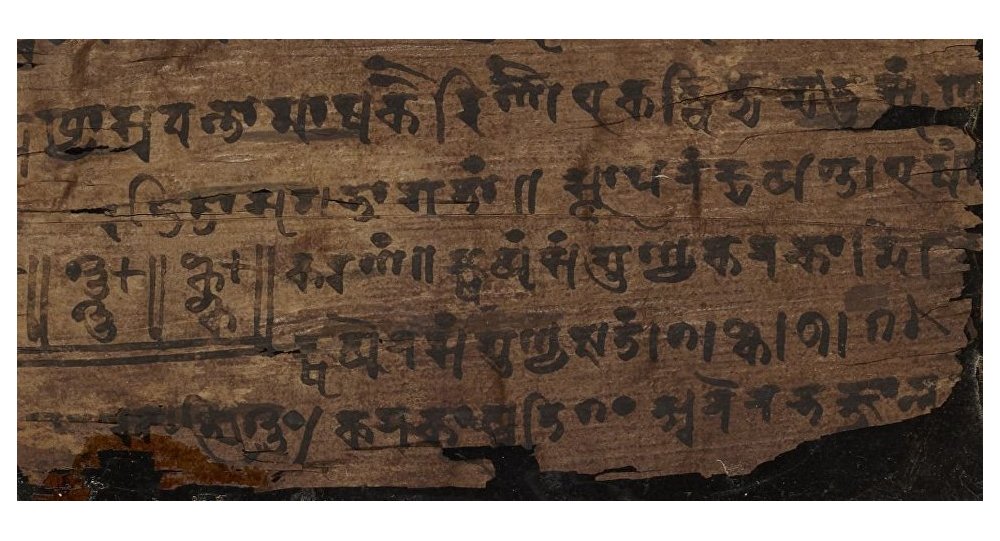
The study of an ancient Indian manuscript containing the numeral zero has been dated back to the 3rd or 4th century, confirming the symbol gained the status of a numerical value five centuries prior to what earlier studies had proven.
Axar.az reports citing Sputnik that, new research based on ancient Indian mathematical records preserved at Oxford University has revealed that zero was in use by Indians almost five centuries earlier than previously thought. Earlier studies had concluded that the first evidence of the use of zero was in the 9th Century in India itself.
The new conclusion was arrived upon after a carbon-dating test on an Indian manuscript at Oxford University revealed that it dated back to the 3rd or 4th Century AD. The manuscript, which is now the first known example of the use of zero as a digit in mathematics, was discovered by a local farmer in 1881 in Bakhshali, a village in what is today Pakistan. The manuscript was named after the village and has been kept in Oxford University’s library since 1902.
The Indian Mathematical Society, founded in 1907, has welcomed the new discovery and has called upon the concerned agencies to further settle the question of the script and the content of the manuscript with global cooperation.
“It is welcome news for all of us. It further ascertains India’s leadership in Mathematics. Now the question of what remains within the manuscript as a piece of information needs to be decoded with mutual cooperation internationally. The discovery of the period of the manuscript is important but the message in it is equally significant if not more,” Prof. N. K. Thakare, General Secretary of the Indian Mathematical Society, told Sputnik.
In the Bakhshkali manuscript, the number zero appears in a set of 70 leaves of birch bark and it contains mathematical figures and text with some similarity to Sanskrit and researchers at Oxford University say that it could be a training manual for Buddhist monks or even calculations done by traders of those times.
“For India, though the glorious past has been again reaffirmed, for us the worry is the future of Mathematics in India. It is a concern that we in this country today are not investing in the future and research seems to have taken a backseat,” he added.
Until now, the first recorded use of zero was considered to be that in from the inscription on the walls of the Chaturbhuj temple near the city of Gwalior in the state of Madhya Pradesh in India. It is a popularly held belief that the idea of nirvana, which is the transcendent state of “nothingness” after liberation from desires and sufferings gave inspiration to the use of a symbol for zero or ‘nothing’ in the temple wall.
Although, there are several pieces of evidence of the use of zero as a placeholder in many ancient cultures like the Mayans and Babylonians; however, it was Indian dot or zero which was the first to gain status as a symbol in mathematics. Zero’s significance increased all the more in modern times, as it became a key building block for the digital world.


|
Date
2017.09.16 / 16:19
|
Author
Axar.az
|