

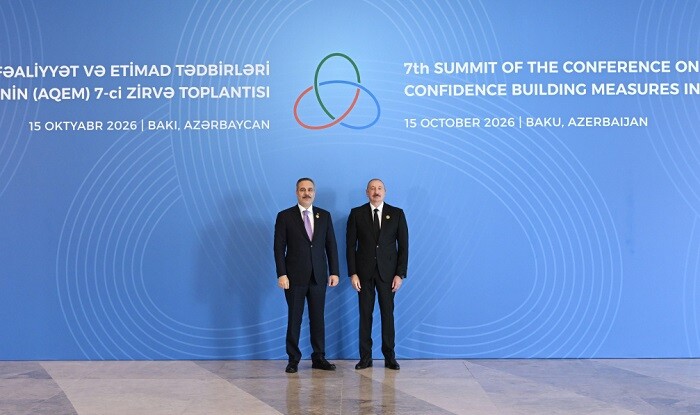
President Ilham Aliyev addressed 7th CICA Summit - Photo
20:42
| Home page Science |

|
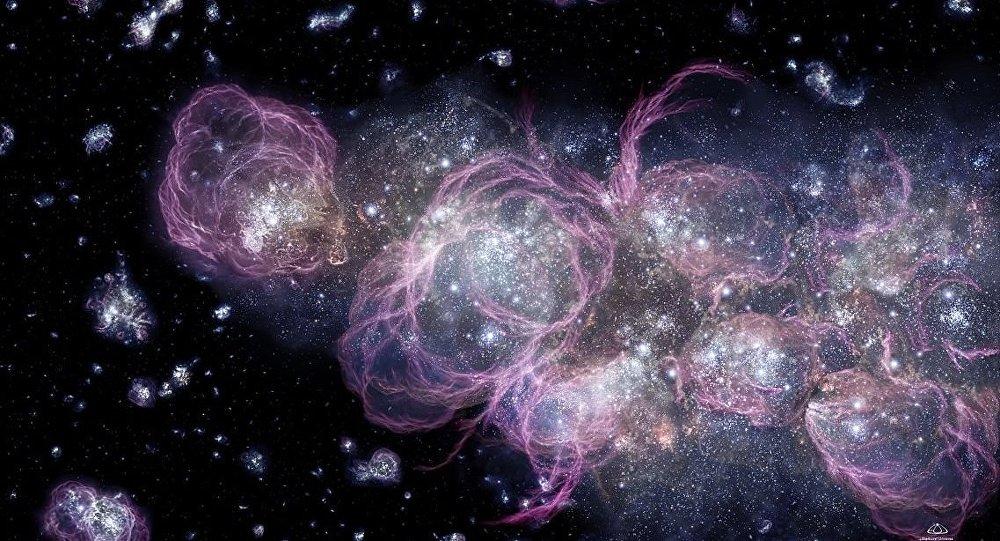
The Big Bang is a widely accepted explanation for the origins of the universe; however, Brazilian physicist Juliano Cesar Silva Neves has come up with a new "cyclical" theory, which challenges this prevailing concept.
Axar.az reports citing Sputnik that, a scientist in Brazil has proposed a way of overcoming a problem of the Big Bang theory, the need for the singularity of spacetime, by doing away with the theory altogether.
In an article entitled, "Bouncing cosmology inspired by regular black holes," published in the September issue of the General Relativity and Gravitation journal, Neves puts forward the notion that the universe expands and contracts in a cyclical way.
"One of the consequences of my work could be a 'cyclical' vision of the universe," Juliano Cesar Silva Neves, a physicist at Brazil's University of Campinas (IMECC-UNICAMP), told.
"My proposed cosmological model, of course, acknowledges the expansion of the universe and also other known phenomenon such as cosmic radiation. For me, the main issue is the Big Bang and the state of initial singularity. That is, the [theorized] first stage of the universe's existence, a state in which the physical and geometric quantities that figure in Einstein's theory of relativity, do not have a set value."
"In the words of mathematicians, these quantities tend toward infinity. This can be perceived as a problem with the theory of relativity, and most of the scientific community thinks that in the future this can be solved with the help of a theory of quantum gravity, which does not yet exist," Neves explained.
There is no generally accepted theory for quantum gravity, which would reconcile the theories of general relativity and quantum mechanics. It is hoped that such a theory could provide a satisfactory description of the microstructure of spacetime at the so-called Planck scale, the universe's minimum limit, beyond which the laws of physics break.
"However, the problem of initial singularity can be solved without resorting to quantum theories, as I show in my work. In this model, there is no moment in the initial phase during which these quantities would have infinite values, and in addition, that phase is not necessarily the first one. That is, I reject the idea of the explosion and propose instead a rebound or ricochet. If that exists, then before the current expansion of the universe there was another, previous phase. If the universe is currently expanding, it means that before that it contracted."
"On that basis, it's possible to construct a cyclical model, where the universe experiences successive phases of compression and expansion," Neves said.


|
Date
2017.11.30 / 15:24
|
Author
Axar.az
|