




Bayern thrash Leipzig 6-1 as Diaz scores hat-trick
09:34
| Home page Society |

|
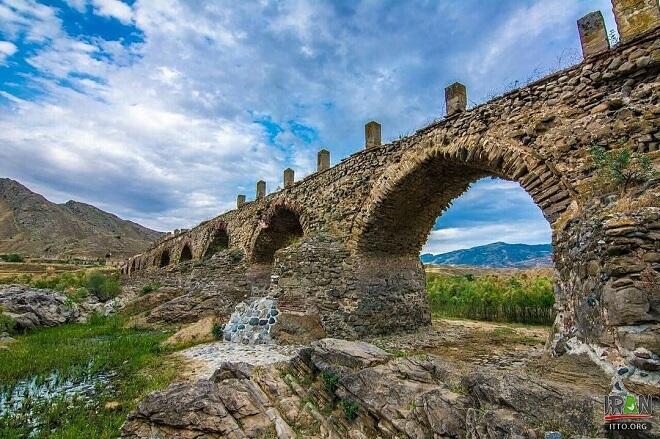
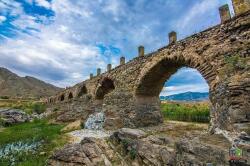
Today, October 18, marks six years since the Khudafarin Bridge, located over the Araz River on the Azerbaijan-Iran border in the Jabrayil district, was liberated from Armenian occupation.
Axar.az reports that on October 18, 2020, in addition to the Khudafarin Bridge, two other settlements in Jabrayil — Hajili and Haji Isagli villages — were liberated from occupation.
The 11-arch Khudafarin Bridge, built in the style of the Azerbaijani school of architecture, is a remnant of a bridge dating back to the 11th–12th centuries, located over the Araz River on the Iran-Azerbaijan border. It was built of stone and faced with large, finely cut stone slabs.
Researchers believe that it was rebuilt in the 13th century, during the rule of the Ilkhanids (Hulaguids), on the remains of an ancient bridge. The bridge is approximately 130 metres long, six metres wide and 12 metres high above the river. Today, its three central arches remain intact, while the arches at the riverbanks were demolished in the 1930s by a decision of the Soviet Union.
The 15-arch Khudafarin Bridge is dated to the 13th century. According to Hamdallah Mustawfi Qazvini, it was built in the 15th year of the Hijri calendar (639 AD) by Bakr ibn Abdullah, a close companion of the Prophet Muhammad. As the supports of the bridge’s arches rest on natural foundations formed by rocks, its spans vary in size and are arranged irregularly.
Built of fired bricks and river stones, the bridge is approximately 200 metres long, 4.5 metres wide and reaches a maximum height of 12 metres above the river.


|
Date
2026.10.18 / 09:12
|
Author
Axar.az
|