



Archaeologists uncover ancient structures in Beylagan - Photo
13:35
| Home page Society |

|
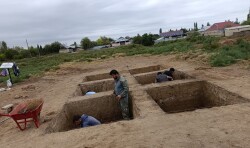
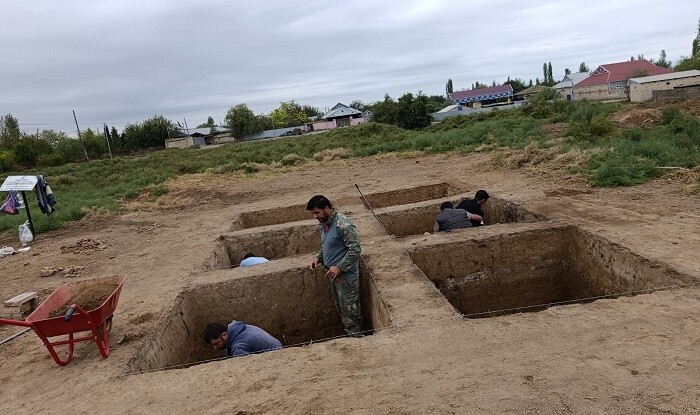
Archaeologists have uncovered mud-brick flooring and remains of red brick walls during excavations in the village of Tazakend, Beylagan district. The findings suggest that the ancient settlement on the Mil Plain was inhabited over several different periods.
Axar.az reports, citing the Public Relations Department of the Institute of Archaeology and Anthropology of the Azerbaijan National Academy of Sciences (ANAS), that the excavations were led by the institute's researcher, Abdulla Abdullayev.
The expedition first conducted a preliminary survey of the site in July 2026, followed by a test excavation in August. Full-scale archaeological excavations took place between September 14 and October 13. Research conducted across six excavation squares showed that the cultural layer extended to a depth of approximately one meter.
In excavation square A, researchers found a mud-brick floor made of bricks measuring 40 × 35 cm at a depth of 97 cm. In square B, they discovered remains of red fired-brick masonry at a depth of 92–93 cm. Ceramic fragments, construction materials and bone remains were also found and documented.
The Tazakend archaeological site was first recorded in 1936 by I.P. Shcheblykin during a surface survey. The first systematic excavations were carried out between 1953 and 1957 by the Orenkala expedition led by A.A. Iessen. A test trench dug by G.M. Ahmadov in 1957 showed that the cultural layer extended to a depth of 3.5 meters.
Ceramic finds and silver denarii dating back to the reign of Octavian Augustus, discovered during earlier excavations, suggest that the settlement was inhabited from the 2nd–1st centuries BC until the 5th–7th centuries AD.
A.A. Iessen and G.M. Ahmadov identified the site as the remains of Paytakaran, a city that existed during the early medieval period.
Further excavations to the north and west of the current site are needed to verify this theory, determine the layout of the discovered structures more accurately and uncover additional evidence to establish their age.


|
Date
2026.11.25 / 13:35
|
Author
Axar.az
|