


Estonia moves bill limiting Russians’ property purchases
21:33
| Home page Science |

|
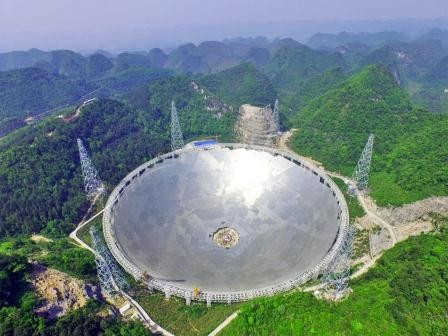
China has taken a big step forward in space exploration: a huge radio telescope – the largest in the world – has begun operating from its base in Guizhou province in the southwest of the country.
The facility, part of China's drive to become a science powerhouse, was opened at a ceremony on 25 September.
China has taken a big step forward in space exploration: a huge radio telescope – the largest in the world – has begun operating from its base in Guizhou province in the southwest of the country.
The facility, part of China's drive to become a science powerhouse, was opened at a ceremony on 25 September.
With the telescope, China enters the next phase of its research renaissance - and the world is now watching to see if it can live up to its promise.
The telescope works by "listening" for radio waves emitted by objects in space. Because this structure is so big, it is able to collect signals from the far reaches of the cosmos.
After construction was complete, Prof Peng Bo, deputy project manager of the FAST said the instrument was able to detect radio waves from three pulsars, which are rapidly rotating, extremely dense stars. They are a key scientific target for the team.
FAST will replace the Arecibo Observatory in Puerto Rico, which is around 300m in diameter, as the world's largest telescope.
Beijing hopes the telescope will symbolize a transition towards investment in science and technology, and away from cheap manufacturing.
Engineers say more than 100 tests were performed in preparation for the launch.
Some 8,000 people were evacuated from the valley in Guizhou province where it has been built as it needs a quiet environment, with radio silence within a five-kilometer radius.
Prof Nan Rendong, who is the mastermind of the telescope and its chief scientist, said that collaboration with the global scientific community would be a vital part of the project.
"As soon as the telescope works normally, a committee will distribute observation time according to the scientific value of the proposals. Proposals from foreign scientists will be accepted and there will be foreign scientists on the allocation committee."
The telescope will eventually become a powerful tool for astronomers. Once fully operational, it will survey neutral hydrogen in distant galaxies and detect faint pulsars (highly magnetised balls of neutrons) and help in the search for extraterrestrial life. Therefore, it could transform our understanding of the universe - to see the first stars and even look for signs of life.


|
Date
2016.10.17 / 17:45
|
Author
Valeh Mammadli
|