

Zelensky thanks countries for supporting Ukraine
01:00
| Home page Politics |

|
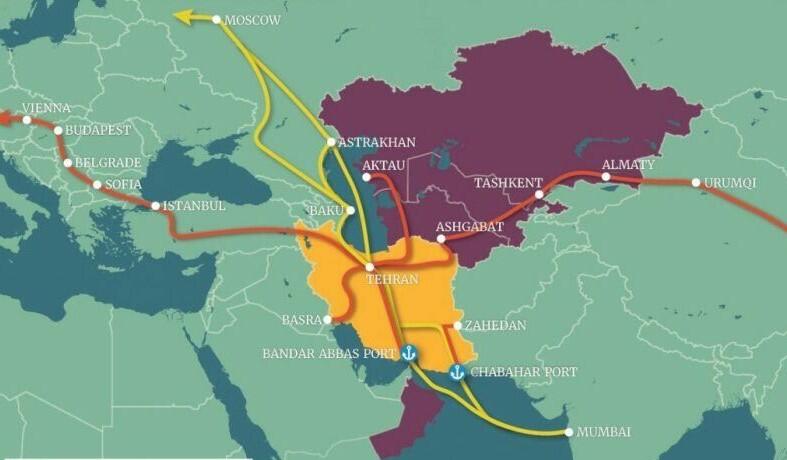
The Italian publication "Scenari Economi" reported that the Trump administration is looking for a new logistics route through Turkiye and Russia that could bypass the EU in order to reduce its dependence on China.
Axar.az informs that, according to the report, Turkiye cannot be left out of the global equation due to two main factors.
The article, which uses the phrase "who controls the routes controls the world," emphasizes that the EU, struggling within the framework of bureaucratic rules, will be left out of the new and surprising logistics and economic axes that will shape the next decade. However, Turkiye cannot be left out of this equation due to its geopolitical position and abundance of natural resources.
According to the assessment, the US is looking for a new balance with Russia in the fields of energy and rare earth elements in order to reduce its strategic dependence on China. At the heart of this search is the creation of an alternative logistics route that does not pass through Turkey and the European Union.
The article emphasizes that the Trans-Siberian Railway, which has long been considered only as a transport network, can once again become a key tool in global geopolitics. According to the scenario, strategic resources from Central Asia could be transported via Russia to the Pacific coast and from there directly to technology centers in California. This would effectively break China's global dominance in rare earth elements.
The analysis stated that the Central Corridor, which stretches from the Caspian Sea to the West through Azerbaijan and Turkiye, poses a serious risk of dependency for the United States rather than strategic convenience. If the route operates at full capacity, Washington's need or "dependence" on Ankara will increase, which will increase Turkiye's geopolitical negotiating power.
According to the Italian newspaper, while the United States is trying to reduce its dependence on China in terms of production and raw materials, it does not want to depend on a new logistics model centered on Turkiye. This US-Russia axis scenario, discussed in the European press, has once again brought to the fore the question of whether Turkiye can be removed from the global logistics map. However, according to experts, current geopolitical and economic realities indicate that this possibility is unlikely.
The article also states that Turkiye, with its unique position connecting Central Asia, the Caucasus, the Black Sea, and the Eastern Mediterranean, is not only a transit point but also one of the main nodes of the logistics chain.
According to experts, rare earth elements have emerged as a key determinant in the energy and logistics debate. These resources, indispensable for the defense industry, electric vehicles, battery technologies, and renewable energy systems, have become one of the main directions of global energy competition.
With approximately 694 million tons of reserves, Turkiye is among the countries with the largest reserves of rare earth elements in the world after China. According to analysts, this potential has transformed Ankara from a mere transit country into a direct owner of a strategic resource.


|
Date
2025.12.14 / 16:17
|
Author
Axar.az
|