
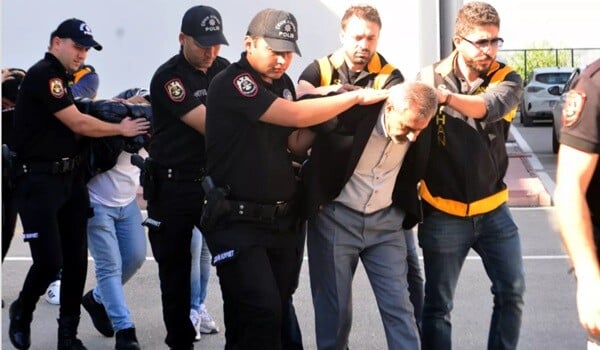
36 arrested in investigation into Yazicioglu's death
10:34
| Home page Politics |

|
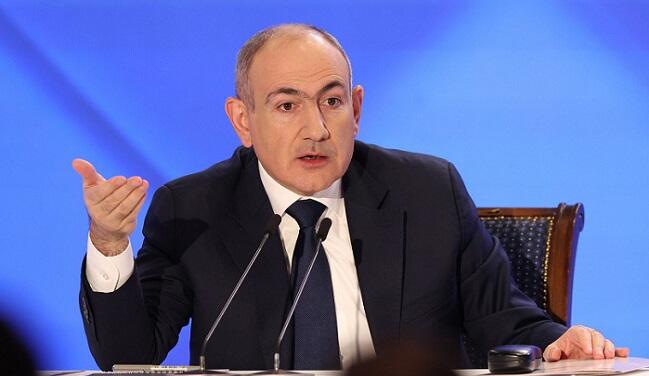
In recent years, we have made significant investments and carried out major reforms in our military, said Prime Minister Nikol Pashinyan in a congratulatory statement on the 34th anniversary of the formation of the Armed Forces of Armenia.
Axar.az informs, citing Armenian media, the first is the voluntary certification program, which has enabled the remuneration of servicemen to increase—up to doubling—depending on their professional skills. Today, tens of thousands of servicemembers in our military receive salaries that are 30, 50, 100 percent, and even higher compared to the period before voluntary certification, thanks to this program.
In our army, many enlisted servicemen receive salaries of 700,000 drams. Officers’ salaries can exceed 1 million, 1.5 million, or even 2 million drams. This represents an important social guarantee for servicemembers, their families, and society as a whole, instilling confidence in the professional level of our servicemembers and in the existence of a motivational system aimed at continuously improving that level.
In recent years, a vast amount of modern weaponry and military equipment has been acquired—of a quality and specification that our army has never had before. Significant financial resources have been invested in this, as the equipment is both expensive and substantial in quantity.
However, a very important question must also be addressed: why was the same not done in 2018, 2019, 2020, 2021, and 2022?
Nearly all of our international partners with the potential to sell weapons and military equipment were politely refusing to sell arms to the Republic of Armenia, citing two main reasons:
1) They were not confident that the weapons would not be deployed outside the internationally recognized territory of the Republic of Armenia.
2) They were not confident that the classified specifications of these weapons would remain secure from the CSTO, to which Armenia’s membership was also an obstacle in concluding such deals.
Meanwhile, as of September 2022, CSTO partners were refusing to fulfill their contractual obligations toward the Republic of Armenia to guarantee its security and territorial integrity. They were also refusing to deliver hundreds of millions of dollars’ worth of weaponry and military equipment for which Armenia had already made payments.
This constituted an existential threat to the Republic of Armenia, and it became evident that a decision had been made to eliminate our statehood and reduce our sovereignty to zero.
This existential danger was overcome thanks to two decisive developments: the political agreement reached on October 6, 2022, in Prague in a quadrilateral format, under which the Republic of Armenia and the Republic of Azerbaijan recognized each other’s territorial integrity and sovereignty based on the 1991 Alma-Ata Declaration; and the freezing of Armenia’s membership in the CSTO.
We will consistently continue this strategy. We clearly state—and will continue to state—that the Armed Forces of the Republic of Armenia have no mission, and will have no mission, beyond defending its internationally recognized territory of 29,743 square kilometers, except for participating in peacekeeping missions based on international treaties.
As for the occupied territories of the Republic of Armenia, the formula for resolving this issue, as outlined in the regulations governing the joint activities of the border delimitation commissions of Armenia and Azerbaijan, already has the highest legal force in both countries, and the issue will be resolved within the framework of the border delimitation process.
But I also want to emphasize: we are not preparing for war, because there will be no war. Peace has been established between the Republic of Armenia and the Republic of Azerbaijan, and there is no more reliable guarantee of security than peace.
We will continue to strengthen this most reliable guarantee of security.


|
Date
2026.01.28 / 13:30
|
Author
Axar.az
|