


Israel kills senior Hamas commander in Gaza strike
14:34
| Home page Culture |

|
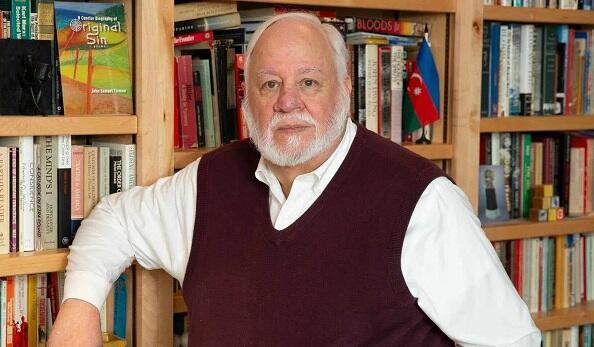
Axar.az presents an article, “Poets, Politicians” by John Samuel Tieman
Poets are perhaps the most stereotyped of all artists. I'm a poet. I hear it all the time. We're soft, sweet, emotionally oowie gooie. Folks who think this have never spent an hour with a drunken poet. No one is particularly surprised that novelist J. D. Salinger served with the army's 4th Infantry Division during World War II. Everyone seems surprised that Howard Nemerov, the Poet Laureate, saw combat as a fighter/bomber pilot during that same war.
I was sitting in our Council Chambers. This was before I was elected, when I was still a candidate for the City Council here, in University City, Missouri. Behind me, someone who didn't know me said dismissively, “Can you believe it? One candidate is a poet. A poet!” On behalf of all poets I'd like to say, “Oh, hell no!” Percy Shelley says, “Poets are the unacknowledged legislators of the world.” Yeah, and some poets are actual legislators.
I've known serious poets who were – a fisherman, a physician, a soldier, two folks in real estate, a lawyer, a banker, a felon, lots of teachers, a psychologist, a journalist, musicians, an insurance guy, a priest, and this list could go on. So why not a politician?
Below is a list of seven prominent poets who are known internationally. Six of them were elected. A special mention goes to one who was appointed. This is a list that could go to 100 respected poets known internationally, nationally and locally. In this list, I emphasize the poetry and the office. I avoid comments about controversial parties, issues or positions.
First, Dante. Yes, that Dante, Dante Alighieri, the “Divine Comedy” guy. I am always a bit wary of talking about elected office in a premodern context. It's not the same as being elected in a contemporary republic. Be that as it may, Dante served on the city council in Florence. Indeed, it was his politics that led to his exile, and it was his exile that led to the composition of his masterpiece.
Thomas More. The “Man For All Seasons”. Folks know of More's last few years, years that led to his martyrdom and sainthood. Prior to that, however, he was a workaday politician. More served in a wide range of offices elected and appointed. He was elected to Parliament, where he represented Great Yarmouth and later the City Of London. He served eventually as Speaker Of The House. Best known for “Utopia”, More also wrote nine plays and a book of epigrams in Latin.
Pablo Neruda. The Nobel Laureate from Chile was elected senator from the provinces of Tarapacá and Antofagasta. He also had a notable diplomatic career, culminating in his appointment as Chile's Ambassador to France. During his time as consul in Madrid, he befriended Rafael Alberti, Federico García Lorca, and the Peruvian poet César Vallejo.
Yevgeny Yevtushenko. (On a personal note, I had the privilege of hearing Yevtushenko recite his masterpiece, “Babi Yar”.) A Russian, he was elected as a representative from Kharkivin to the Congress of Peoples' Deputies, the national parliament, where he served for many years.
Václav Havel. Havel was the president of Czechoslovakia and later the Czech Republic. Havel is probably best known for his plays. He was also a noted poet.
Aimé Césaire. Considered one of the founders of the Négritude movement in Francophone literature, he indeed coined the word “négritude” in French. He served for over two decades in elected office. Césaire was a deputy to the French National Assembly for Martinique. He finished his career as Mayor of Fort-De-France, the capital city of Martinique. His works include the book-length poem, “Notebook Of A Return To My Native Land”.
While he never ran for an elected office, special mention must go to Archibald MacLeish, who served as Assistant Secretary Of State For Public And Cultural Relations, which today is entitled the Assistant Secretary Of State For Global Public Affairs. He was the recipient of three Pulitzer Prizes, two for his poetry and one for his play “J. B.” For his poetry, MacLeish also was awarded the National Book Award and the Bolligen Prize.
It seems fitting to close with a poem, “The Riddles”, a poem by Senator Pablo Neruda. His poem is from his book, “Canto General “ (México: Talleres Gráficos de la Nación, 1950). The senator's poem below is translated from the original Spanish by me and Paola De Santiago Haas. Our translation first appeared in “Vox Populi”.
***
“The Riddles”
You have asked me what the crustacean spins between its limbs of gold
and I answer: the sea knows it.
Tell me what the ascidian waits for in its transparent bell. What are you waiting for?
I tell you, like you it waits for time.
You ask me who the brown algae reaches with its embrace.
Investigate it, investigate it at a certain hour, in a certain sea I know.
Without a doubt you will ask me about the damned ivory of the narwhal, that I may explain
how the harpoon agonized the unicorn of the sea.
You ask perhaps for the plumes of the blue coral that tremble
in the pure origins of the southern tide?
And over the crystalline construction of the octopus you have considered, without a doubt,
one more question, undoing it now?
Do you want to know the electric matter of the pikes of the bottom?
The stalactite army that walks cracking?
The hook of the angler fish, the music extended
in the deep like a thread in the water?
I want to say that the sea knows this, that life in its arks
is as wide as the sand, innumerable and pure
and among the blood grapes time has polished
the hardness of one petal, the light of the jellyfish
and has undone the bouquet of their coral strands
from a cornucopia of infinite mother of pearl.
I am nothing but the empty net that advances
human eyes, dead in that darkness,
fingers accustomed to the triangle, measures
of a timid hemisphere of orange.
I walked like you, digging up
the interminable star,
and in my net, in the night, I woke up naked,
only prey, a fish enclosed in the wind.


|
Date
2026.01.12 / 09:52
|
Author
Axar.az
|