


Azerbaijani, Turkish FMs discuss bilateral ties in Baku
00:51
| Home page Science |

|
Investigating an incident that occurred hundreds of millions of miles away can be tricky. But with a little help from NASA’s Mars Reconnaissance Orbiter, European Space Agency officials are getting closer to figuring out exactly what happened with their Mars lander, Schiaparelli.
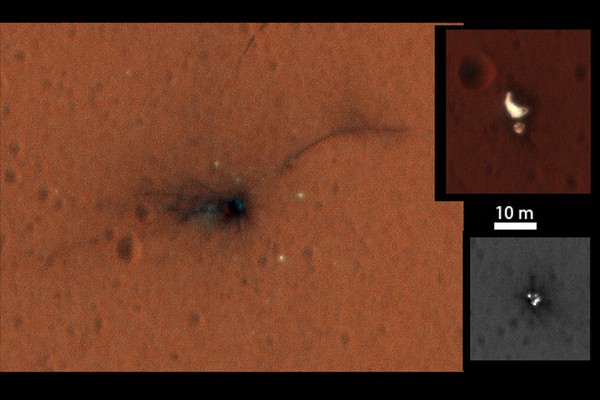
A week after the site was photographed in black and white, NASA’s orbiter passed over the site again, taking new color photographs. The images have been pieced together, providing a view of the entire impact site and helping to clear up some speculations. Fragments of the lander are visible, supporting the hypothesis that the lander crashed, while photos of the rear heat shield suggest it burned as expected.
The images are the latest clue in the evolving mystery of what, exactly, happened to Schiaparelli. The landing was always intended as a test of the ESA technology, which had been developed to cope with the unique challenges of landing on Mars. Figuring out what went wrong will allow scientists to address the problem — which some suggest was a software glitch — before the next ESA mission to Mars, scheduled for 2020.
Schiaparelli was equipped with a range of high-tech hardware and software to help it navigate the descent to the surface of the Red Planet. A parachute and thrusters were installed to help it slow down after entering Mars’ atmosphere.
The lander was much too far away to be controlled manually from Earth. It takes at least 26 minutes for signals to make a round trip, while the descent lasts just six minutes. So an advanced computer was deployed to run the landing automatically.
But all did not go as planned. Schiaparelli lost contact with Earth, and black and white images taken by NASA’s Mars Reconnaissance Orbiter showed what appears to be a new crater on the planet’s surface. ESA scientists said that the impact crater was consistent with Schiaparelli crashing into the ground at 186 miles per hour.
The new color photos appear to corroborate that theory. The bright white spots around the dark region identified as the crash site appear in both sets of photos, for instance, allowing the ESA to conclude that they are "most likely to be fragments of Schiaparelli," rather than image "noise."
Images of the rear heat shield, meanwhile, show a pattern of bright and dark patches. This seems to indicate that the heat shield performed as expected: "the external layer of insulation has burned away in some parts and not others."
The parachute appears to have shifted in the wind, the new photos show. The Mars Reconnaissance Orbiter previously observed something similar happening to Curiosity’s parachute, so this, too, is as expected.
But scientists looking at the black and white photos highlighted the location of the parachute and heatshield, saying their distance from the new crater is consistent with both pieces being ejected sooner in the descent than they should have been. That adds up to a picture of confused landing software causing Schiaparelli’s demise.
"Fundamentally there’s a software issue here between the radar and the on-board computer system," Mark McCaughrean, a senior science advisor at ESA, told the Associated Press. "The radar was giving inconsistent info on where it was."
The good news is, it shouldn’t be impossible to fix.
"As it is, we have one part that works very well and one part that didn’t work as we expected," Jorge Vago, project scientist for ExoMars, told Nature after the earlier photos were released. "The silver lining is that we think we have in hand the necessary information to fix the problem." The new photos will help with that.
The ESA said that its probe into the incident should be completed by the end of November. An independent inquiry board has also been initiated.


|
Date
2016.11.06 / 12:55
|
Author
Axar.az
|