



Azerbaijani, Turkish FMs discuss bilateral ties in Baku
00:51
| Home page Science |

|
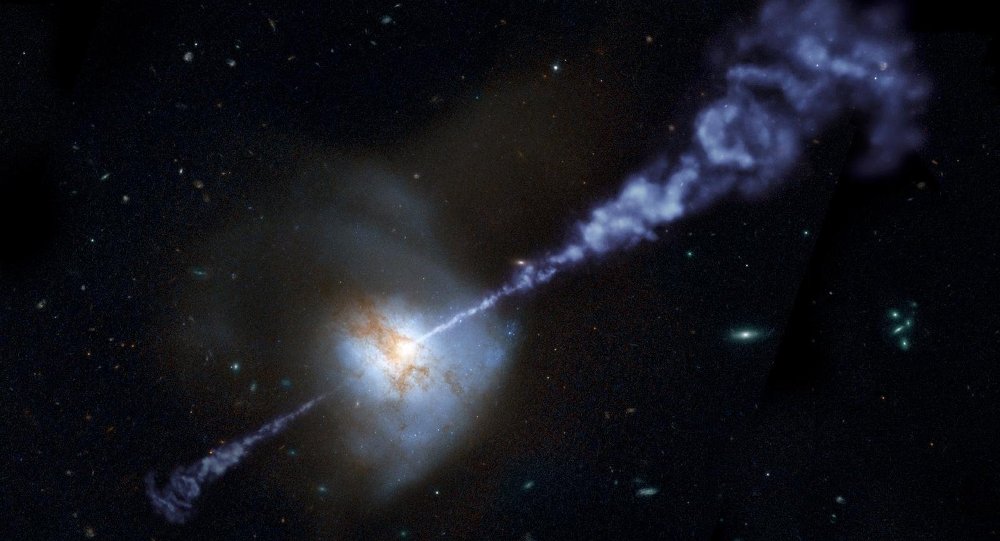
An international team of astronomers has found evidence of the mysterious “missing link” black holes that explains the gap between small and supermassive black holes. The black hole is hidden in the Sagittarius constellation at the Milky Way’s galactic center.
The black hole is located approximately 26,000 light years from Earth in the Milky Way's globular cluster, which is a region of space densely populated by millions upon millions of older stars. Globular clusters form in the centers of galaxies, pulled in the powerful gravity of the supermassive stars or black holes that make up the galactic core.
The team, led by Dr. Benetge Perera of the University of Manchester, observed strange behavior from one of the globular cluster's stars: PSR B1820 30A, a superdense and highly magnetized pulsar. PSR was discovered in 1990 by the Lovell Telescope at the Jodrell Bank Observatory in Cheshire, England.
"The pulsar is therefore very sensitive to any motion arising from the gravity of other nearby massive objects, such as black holes, making it easier for us to detect them."
When you hear about black holes, they tend to be either stellar black holes (comparable in size to our sun) or supermassive black holes (millions or billions of times larger than the sun). The awkward middle children of the black hole family are intermediate-mass black holes (IMBH), which are hundreds or thousands of times larger than our sun but still miniscule compared to supermassives.
All black holes are difficult to detect since they give off precious little light, but IMBHs in particular are rarely observed. In fact, there has never been conclusive observation of one before, only indirect and circumstantial evidence.


|
Date
2017.04.29 / 09:44
|
Author
Axar.az
|