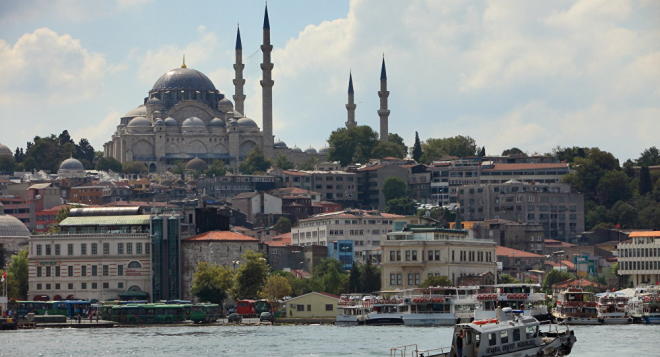




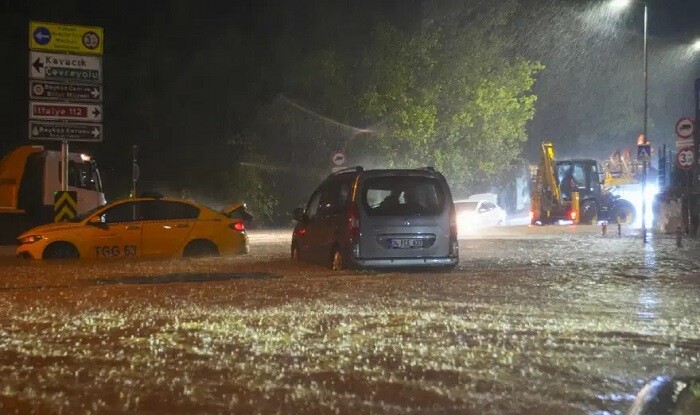
Istanbul flood death toll rises to three
15:50
| Home page Society |

|
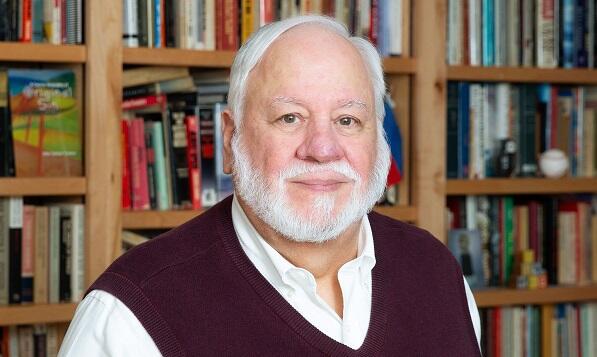
Axar.az presents an article, "Nam Vets And Memory" by John Samuel Tieman.
I'm a Vietnam War veteran. The nation's vision of Nam vets has gone through three phases: the first during the war, then after the war from roughly 1975 to the late 1980s, and the third from say the 1990s until today. I hate each.
Let's start with 1969, 1970. That's when I was in the army. A lot of us, maybe most folks, thought that guys who were in the infantry were unskilled and even unintelligent. I was in complete agreement with that assessment. I had a skill. I was a classically trained musician more familiar with Beethoven than the Beatles. I remember a buddy, a Private First Class, playing a piano while talking to an infantry captain. “So you're a paratrooper? Took you, what, three weeks to learn how to fall out of an airplane? It took me ten years, plus a bachelor's degree from a conservatory, to learn to play this piano. Sir.” That was when I was stationed in Texas. It's worth noting that this vision was widely shared.
Then I got stationed with an infantry division in The Nam. The 4th Infantry Division Band. With the exception of the musicians and folks like the guys in the 4th Medical Battalion, most were indeed unskilled. But that wasn't because they were unintelligent. That was largely because they were just kids drafted straight out of the working class. Two guys I knew were 17. My oldest war buddy, Chuck, we called “Pop”. He was 24. I was 20, by the way. I'd been a classically trained clarinetist since I was 12. I'd played in civic symphonies.
Then I came home. From the time I got home in 1970 until perhaps the late 1980s, we got a second stereotype. Losers. This stereotype was held at the American Legion hall and on the college campus. It was painful. The burden for the loss of the war fell upon the former Privates First Class and First Lieutenants. There was a t-shirt, “Southeast Asian War Games, 2nd Place.” Nam vets were shunned. I once went into an American Legion hall in Denton, Texas. No one spoke to me. The bartender didn't serve me.
I dropped my service from my resume. I was far from unusual. Unless you were a friend, I never mentioned the army. I knew my wife, then my friend, for four years before I mentioned that I was a Nam vet. I retreated into a world of lectures and a master's thesis. Stories of Nam vets being spit on notwithstanding, my experience was one of isolation. I went to private universities where upper-class kids avoided military service. The war was a subject that didn't come up much. Besides, I didn't want to hear it. “What's it feel like to kill someone?” “How many people did you kill?” I just didn't want to hear it.
While that was a distortion, perhaps the greatest distortion is happening now. There has been this dramatic turn that began in the late 80s. In this third vision, we went from losers to heroes all. “Thank you for your service.” The idea that every single Vietnam veteran is a hero among heroes. It allows for no variation. It's painful. It doesn't allow for the guy who served as a clerk. Nor does it allow for the guy who made a necklace of the ears of people he'd killed. Yes, there are war heroes. Tony won two – Two! – Distinguished Flying Crosses for two rescue missions he flew. But this latest vision doesn't allow for this simple fact. The vast majority of us did everything we could just to come home alive and in one piece.
A few years ago, I did a completely unscientific internet survey of veterans. I asked, simply, how they felt when folks did that “Thank you for your service” thing. Over 600 responded. The word “awkward” came up a lot.
For the record, I did nothing either heroic or noteworthy. And one other thing. I don't hate the army. I hate what I became because of the war.
We grow old, we Nam vets. Most of us are in our 70s and 80s. I can't speak for us all. But I wish, before we go, that folks would just see us for who we are. We served. For the most part, we did our duty. Then we came home, went to work, went to the university, had a family, all that. One buddy was a union shop steward. Another a banker. This one was a nurse, and that one a train engineer. One war buddy of mine did five years in federal prison for selling heroin. Another war buddy is a retired social worker. I was a teacher. Are my war buddies heroes all? No. Well, one was.


|
Date
2026.08.31 / 09:52
|
Author
Axar.az
|