


Qatari mediators return to Tehran to push for US-Iran deal
13:16
| Home page World |

|
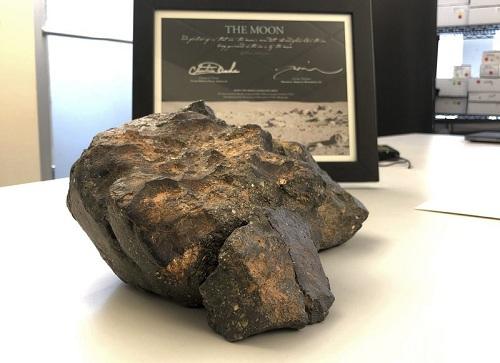
A meteorite found in 2022 in the Sahara in Mali formed in the Martian crust at least 4.1 billion years ago, according to scientists, making the reddish igneous rock perhaps the oldest of the 435 meteorites from Mars known on Earth.
Axar.az reports, citing Reuters, that the researchers said the composition of the meteorite, called Teghaza 001, is providing insight into the environment early in the history of Earth's planetary neighbor, with fresh evidence of liquid water on the surface that bolsters the notion that primordial Mars may have been conducive to microbial life.
Planetary scientist Yang Liu of NASA's Jet Propulsion Laboratory in California, which is managed by Caltech, called the meteorite "a witness to a time when Mars was likely warmer and wetter than it has been for most of its history.
The chemistry of the meteorite, a type of coarse-grained rock called gabbro, shows that it experienced interactions with water when it was slowly cooling and crystallizing in the Martian subsurface. It was part of the Martian crust, the planet's outermost layer, but formed from magma originating at greater depths in the planet's mantle.
Mars is now cold, dry and desolate, but extensive evidence indicates it had water flowing on its surface in the form of rivers, lakes and an ocean in the northern hemisphere billions of years ago.
Teghaza 001 was discovered in eight pieces, with the largest chunk about the size of a fist, in the desert roughly 21 miles (34 km) from the Malian village of Bir Chali. Its main minerals are feldspar and pyroxene, and it contains zircon crystals bearing the element uranium. The researchers ascertained its age using a technique based on the decay of uranium into lead over time.
"Martian meteorites are our only samples from Mars, forming our basis for understanding the formation and differentiation of early Mars and allowing us to evaluate in laboratories whether ancient Mars could have supported habitable conditions," said Liu, lead author of a study on the meteorite published in the journal Science.
"The detailed information we can extract from these meteorite samples complements and validates our exploration of Mars using satellites, landers and rovers," Liu said.
This information provides clues about how the evolution of Mars diverged from Earth's when they were in their infancy and life was beginning to take hold on our planet, Liu said. Earth, Mars and the solar system's other planets formed roughly 4.5 billion years ago.
Only three Martian meteorites, including Teghaza 001, date to the planet's early history. One of them, discovered in Antarctica in 1984, was initially assessed as being about 4.5 billion years old but more recently was determined to have a similar age to Teghaza 001. Teghaza 001 likely is the older of the two, according to the new study.


|
Date
2026.10.30 / 12:16
|
Author
Axar.az
|