

Russian footballer Daniil Vinter dies in car crash at 24
13:35
| Home page Politics |

|
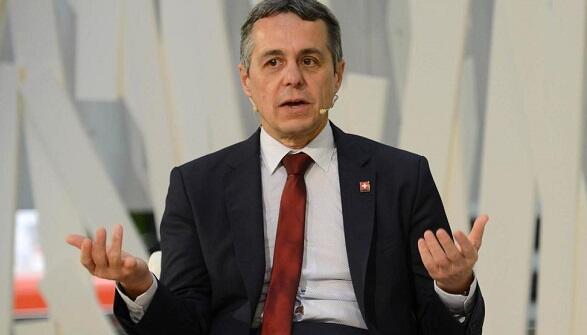
Ignazio Cassis, Federal Councillor and Head of the Federal Department of Foreign Affairs of the Swiss Confederation, gave exclusive interview to the Azerbaijan State News Agency (AZERTAC).
Axar.az presents the interview:
- Switzerland was among the first countries to recognize the independence of the Republic of Azerbaijan after it regained its independence. Next year, we will mark the 35th anniversary of the establishment of diplomatic relations between our two countries. How do you believe your visit to Baku will contribute to the further development of bilateral ties?
- Switzerland’s early recognition of Azerbaijan’s independence laid the foundation for a strong and lasting relationship between our two countries.
My visit is an opportunity to deepen our political dialogue, strengthen economic cooperation and discuss regional and international issues of common interest. As we approach the 35th anniversary of diplomatic relations, we want to build on what has already been achieved and further strengthen our partnership.
- How would you characterize the current state and momentum of Swiss-Azerbaijani relations?
- Swiss-Azerbaijani relations are solid, dynamic and built on regular political dialogue. The numerous high-level visits and exchanges between our two countries over the years demonstrate the strength and continuity of this relationship.
The progress towards peace with Armenia creates new opportunities for the entire region, including for stability, connectivity and economic cooperation. Azerbaijan is an important partner for Switzerland in the South Caucasus and a key link between Europe and Asia, with a growing role as a regional hub.
Our cooperation within the Bretton Woods institutions is a distinctive pillar of our relationship. Azerbaijan’s membership in the Swiss-led constituency creates trust and enables regular political dialogue, policy coordination and technical cooperation.
Our economic ties are also growing. Switzerland is an important destination for Azerbaijan’s exports beyond the energy sector, which have increased significantly in recent years. We see further potential in trade and investment, particularly in sectors that support Azerbaijan’s economic diversification and innovation.
- Baku is a hub for major global energy projects. How do you assess Azerbaijan’s role in ensuring Europe’s energy security?
- In today’s geopolitical context, diversifying energy sources and supply routes is essential for Europe’s security and resilience.
Azerbaijan has become a reliable energy partner and plays an important role in strengthening Europe’s energy security. Its contribution helps reduce dependence on a single supplier and supports a more stable and diversified energy supply.
Switzerland values Azerbaijan’s constructive role and its commitment to reliable energy cooperation with Europe.
- The Joint Commission on Trade and Economic Cooperation between the Government of the Republic of Azerbaijan and the Swiss Federal Council was established in 2003. How do you assess the role of this platform, which has been operating for more than two decades, in expanding bilateral trade and enhancing the investment climate between the two countries?
- The Joint Economic Commission is a key instrument of our bilateral relations. It allows us to identify concrete opportunities, improve the business environment and bring Swiss and Azerbaijani companies closer together, particularly in sectors beyond oil and gas.
The 10th session, to be held in Switzerland on 15 September, together with the business forum, will provide a valuable opportunity to deepen this cooperation and develop new partnerships.
- We would also appreciate your views on the operations of Swiss companies in Azerbaijan, particularly in the liberated Garabagh and East Zangezur regions, as well as on the potential for future cooperation.
- I believe Swiss companies can bring useful expertise and innovation to the markets in which they operate.
Their investment decisions are made independently, based on market potential, economic viability, legal certainty and the overall business environment. The role of the Swiss government is not to direct these choices, but to help create reliable framework conditions in which companies can invest and develop with confidence.
- Azerbaijan is an important logistics hub connecting East and West. To what extent is Switzerland interested in the development of the Middle Corridor passing through Azerbaijan and in utilizing this transport infrastructure?
- Azerbaijan’s geographical position gives it an important role as a bridge between East and West.
Switzerland is interested in the development of the Middle Corridor because reliable and diversified trade routes are essential for an open and resilient global economy. We see potential for cooperation in areas such as logistics, infrastructure and digitalisation.
The opening of a representative an office in Baku by the Geneva-based Mediterranean Shipping Company MSC last year is a concrete sign of the growing interest in Azerbaijan’s role as a regional transport hub.
- Amid increasing conflicts around the world and in the region, we would appreciate your views on the reconciliation process between Azerbaijan and Armenia, including the prospects for achieving a peace agreement, cargo transportation to Armenia through Azerbaijani territory, Azerbaijan’s fuel supplies to Armenia, and other confidence-building measures.
- Switzerland welcomes the progress made towards peace between Azerbaijan and Armenia and the political will shown by both sides to overcome a conflict that has caused deep suffering over many years.
I express this both as Swiss Minister of Foreign Affairs and as OSCE Chairman-in-Office. I will carry the same message to Yerevan during my forthcoming visit.
Switzerland has a long-standing commitment to dialogue and confidence-building. Geneva hosted talks between the two Foreign Ministers in 2022, and we remain ready to support further steps towards normalization whenever this is useful.
The resumption of trade, transport links and other confidence-building measures is encouraging. We hope both sides will build on this progress and move towards a lasting peace that benefits the people of both countries.
I also look forward to welcoming the Foreign Ministers of Azerbaijan and Armenia to Lugano in December for the OSCE Ministerial Council. During Switzerland’s Chairmanship, we want to strengthen the OSCE as a platform for dialogue. It is one of the few places where all 57 participating States still sit around the same table. In times of tension, keeping this table open is already an achievement; using it to rebuild trust is our responsibility.


|
Date
2026.08.04 / 11:12
|
Author
Axar.az
|