


Russian oil companies ready to supply diesel fuel to US
22:31
| Home page Science |

|
Scientists searching for fast radio bursts that some believe may be signals sent from aliens may be happening every second.
Axar.az reports citing Daily Mail, What was once thought to be a rare phenomenon might be occurring each and every moment of the day, experts say.
Fast radio bursts, or FRBs, are radio emissions that appear temporarily and randomly, making them not only hard to find, but also hard to study.
The mystery stems from the fact it is not known what could produce such a short and sharp burst.
If the mysterious phenomena is indeed a sign of intelligent life in the universe, the latest findings could suggest it is far more widespread than previously thought.
Researchers from the Harvard-Smithsonian Center for Astrophysics (CFA) have estimated how many Fast Radio Bursts (FRBs) should occur over the entire observable universe.
Their work indicates that at least one FRB is going off somewhere every second.
When fast radio bursts (FRBs), were first detected in 2001, astronomers had never seen anything like them before.
Since then, they have found a couple of dozen FRBs, but they still don't know what causes these rapid and powerful bursts of radio emission.
Anastasia Fialkov of the CFA, who led the study, said: 'If we are right about such a high rate of FRBs happening at any given time, you can imagine the sky is filled with flashes like paparazzi taking photos of a celebrity.
'Instead of the light we can see with our eyes, these flashes come in radio waves.
'In the time it takes you to drink a cup of coffee, hundreds of FRBs may have gone off somewhere in the Universe,' added study co-author Avi Loeb.
'If we can study even a fraction of those well enough, we should be able to unravel their origin.'
To make their estimate, the scientists assumed that FRB 121102, a fast radio burst located in a galaxy about three billion light years away, is representative of all FRBs.
Because this FRB has produced repeated bursts since its discovery in 2002, astronomers have been able to study it in much more detail than other FRBs.
Using that information, they projected how many FRBs would exist across the entire sky.
While their exact nature is still unknown, most scientists think FRBs originate in galaxies billions of light years away.
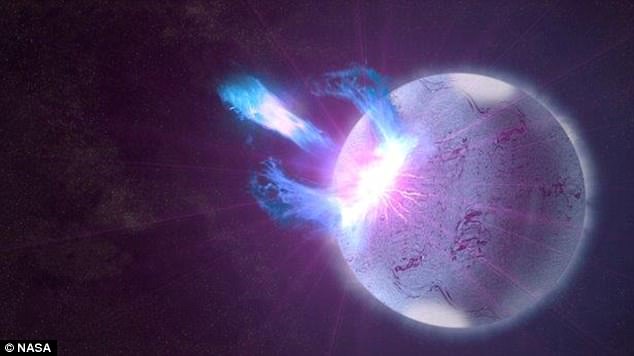
One leading idea is that FRBs are the byproducts of young, rapidly spinning neutron stars with extraordinarily strong magnetic fields.
Fialkov and Loeb point out that FRBs can be used to study the structure and evolution of the Universe whether or not their origin is fully understood.
A large population of faraway FRBs could act as probes of material across gigantic distances.
This intervening material blurs the signal from the cosmic microwave background (CMB), the left over radiation from the Big Bang.
A careful study of this intervening material should give an improved understanding of basic cosmic constituents, such as the relative amounts of ordinary matter, dark matter and dark energy, which affect how rapidly the universe is expanding.
FRBs can also be used to trace what broke down the 'fog' of hydrogen atoms that pervaded the early universe into free electrons and protons, when temperatures cooled down after the Big Bang.
It is generally thought that ultraviolet (UV) light from the first stars traveled outwards to ionize the hydrogen gas, clearing the fog and allowing this UV light to escape.
Studying very distant FRBs will allow scientists to study where, when and how this process of 'reionization' occurred.
'FRBs are like incredibly powerful flashlights that we think can penetrate thise fog and be seen over vast distances,' added Dr Fialkov.
'This could allow us to study the 'dawn' of the universe in a new way.'
The full findings of the study were published in The Astrophysical Journal Letters.


|
Date
2017.09.22 / 17:12
|
Author
Axar.az
|