







Messi and Ronaldo to unite on the same team
7 September 23:53
| Home page Society |

|
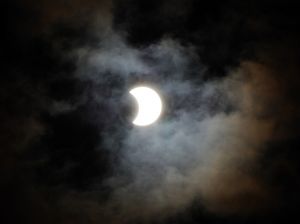
Tomorrow will be the first solar eclipse of the year (annular solar eclipse).
Axar.az reports that the Shamakhi Astrophysical Observatory, named after Nasireddin Tusi, published information about this.
The eclipse will begin on February 17 at 13:56 and end at 18:27. This eclipse, the maximum phase of which falls at 16:12, will be observed mainly over Antarctica. Since the type of eclipse depends on the observer's position, it will be visible in Argentina, Madagascar, the Republic of South Africa, Tanzania, Zimbabwe, Namibia, Seychelles, Mozambique, Chile, Botswana, Malawi, Zambia, South Georgia and the South Sandwich Islands, Mauritius, Reunion, Lesotho, and several other countries.
Eclipses are observed when the Earth or the Moon passes in front of the Sun, partially or completely blocking its light. There is only a 5°09′ difference between the plane of the Earth's orbit and the plane of the Moon's orbit. An eclipse occurs when the new Moon or full Moon phases of the Moon coincide with the nodes of the orbit. An additional condition for a solar eclipse is that the angular dimensions of the Moon's and Sun's disks in the sky are almost the same.
During a solar eclipse, the Moon passes between the Sun and the Earth, preventing the rays from the Sun from reaching the Earth. As a result, the Moon's shadow is formed in certain parts of the Earth's surface, and an eclipse is observed. A solar eclipse occurs only during the new Moon phase.
Depending on the mutual position of the Moon, Earth, and the Sun, solar eclipses are divided into several types: total, annular, partial, and hybrid. The maximum duration of the total phase of a solar eclipse is about 7 minutes. This limitation is due to the relatively small area covered by the Moon's shadow on the Earth's surface.
As the observer moves from the shadow to the penumbra, the percentage of the Moon's covering of the Sun's disk decreases, and a partial solar eclipse is observed, not a total eclipse. In a partial eclipse, the percentage of coverage also depends on the geographical location of the observation site.
Note that this eclipse will not be observed from Azerbaijan. The next eclipse will be a total lunar eclipse on March 3rd.


|
Date
2026.02.16 / 19:31
|
Author
Axar.az
|