



New industrial sector to create over 5,000 jobs
18:55
| Home page Society |

|
Anyone who does a bit of reading will know that all things tend to end with a bang, rather than a whimper. But we’re more or less certain the universe begun with a bang – and today we’ve learned a little bit more about the era after this dramatic moment of creation.
Axar.az informs citing metro.co.uk.
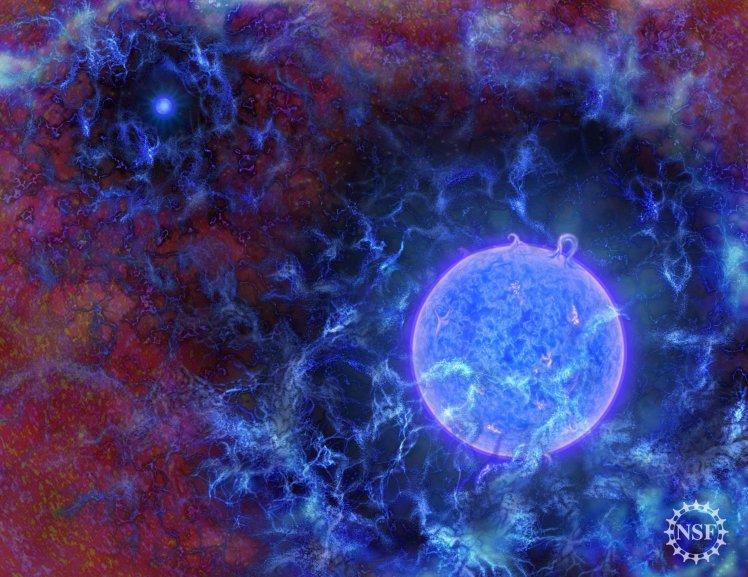
Scientists have detected signals from stars born during the ‘cosmic dawn’ following the Big Bang after a painstaking decade-long search. After that auspicious explosion at the beginning of time, the universe was dark and boring. It had no stars or galaxies to punctuate the endless nothingness of space and was mostly filled with vast clouds of hydrogen gas.
This purgatorial void lasted some 400,000 years before gravity slowly pulled the densest bodies of gas together until they formed the first stars. Now a team lead by Judd Bowman, an astronomer at the Arizona State University School of Earth and Space Exploration, has picked detected signals produced by the first stars created during this astonishing era of genesis. These stars were born just 180 millions years after the Big Bang and are ‘the oldest ancestors in our cosmic family tree’. ‘It is unlikely that we’ll be able to see any earlier into the history of stars in our lifetimes,’ said Bowman.
‘This project shows that a promising new technique can work and has paved the way for decades of new astrophysical discoveries.’ To find these ancient ‘fingerprint’s, Bowman’s team used a radio spectrometer located at the Murchison Radio-Astronomy Observatory Western Australia. They scanned radio signals received across most of the South Hemisphere’s sky and looking for small changes in wavelength. What they found was radio signals produced by the hydrogen gas which filled the baby universe, which contain a vast amount of information on how stars, galaxies and even black holes were created.


|
Date
2018.03.01 / 16:25
|
Author
Axar.az
|