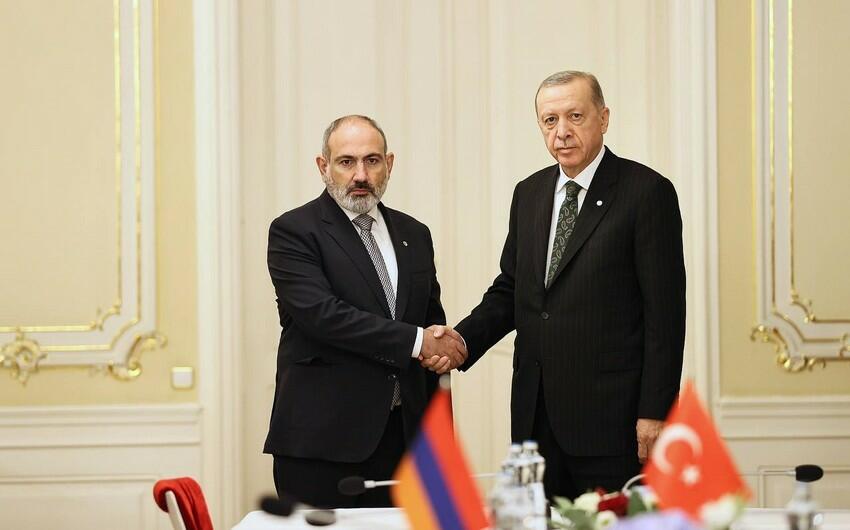
Erdogan, Pashinyan discuss Turkiye–Armenia normalization
00:40
| Home page Politics |

|
Reconciling Turkiye and Saudi Arabia with Israel while managing tensions with Iran will require skillful statecraft from the Trump administration. Azerbaijan is well-positioned to assist due to its unique diplomatic ties. It maintains close relations with Turkiye, the UAE, and Israel, while also engaging Saudi Arabia. Washington can leverage Baku as a key intermediary to coordinate regional actors.
Axar.az reports that this was stated by Kamran Bokhari, senior director at the New Lines Institute for Strategy & Policy in Washington, in an article published in the American magazine National Interest:
"Azerbaijan has already demonstrated both the intent and capability to act as a strategic intermediary in the Middle East. It has hosted deconfliction talks between Turkiye and Israel, underscoring its readiness to bridge regional divides. Baku has also served as a conduit between Israel and the new regime in Syria, exemplified by Ahmed al-Shara’s visit to Baku. Its participation in the Board of Peace further highlights the country’s growing diplomatic importance.
An unparalleled combination of geographic, historical, and sociopolitical factors confers exceptional leverage on Azerbaijan. Positioned along Iran’s northwestern frontier, it borders provinces with large ethnic Azeri populations whose cultural ties to Baku remain strong. Azerbaijan’s secular model, combined with the Iranian Azeris’ presence in senior state and military roles, offers the United States a potential window into Iran’s internal dynamics. Leveraging these connections, Baku could support stabilization efforts and help shape Tehran’s behavior amid ongoing diplomacy and security pressure.
Vice President JD Vance’s Feb. 10–11 visit to Baku advanced US geostrategy by formalizing Azerbaijan’s role in regional stabilization. The two countries signed a Strategic Partnership Charter, committing to enhanced maritime security and economic connectivity. The visit underscores Baku’s strategic value as US lawmakers consider repealing Section 907 of the 1992 Freedom Support Act. Originally enacted during the 1988–94 Armenia-Azerbaijan war and supported by diaspora lobbying, 907 is now largely obsolete following the 2020–23 conflict and the August 2025 peace deal brokered by the Trump administration."


|
Date
2026.02.25 / 15:53
|
Author
Axar.az
|