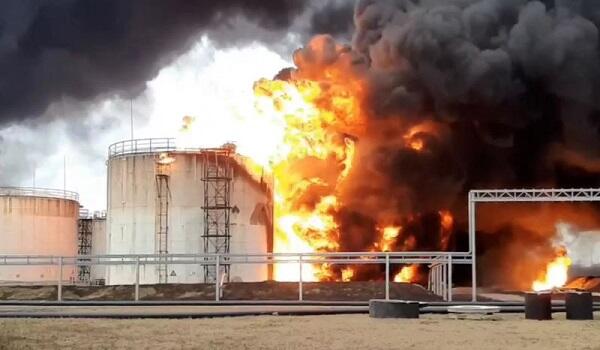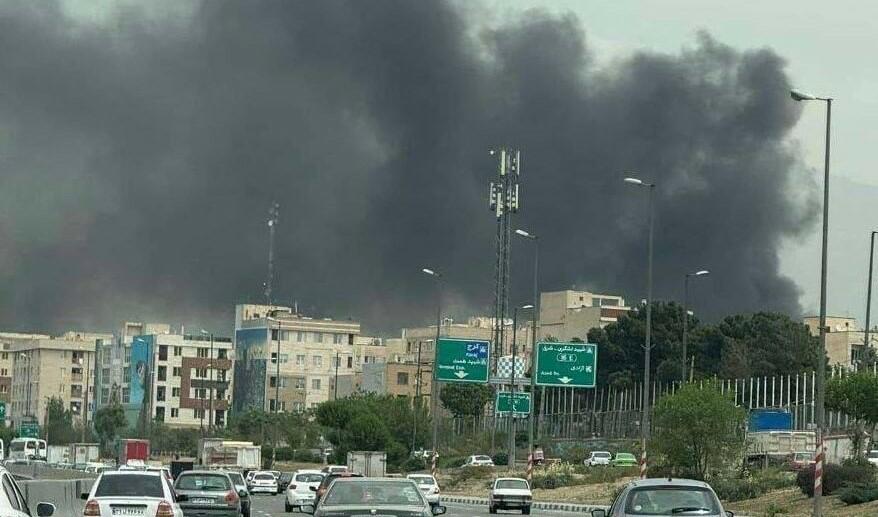
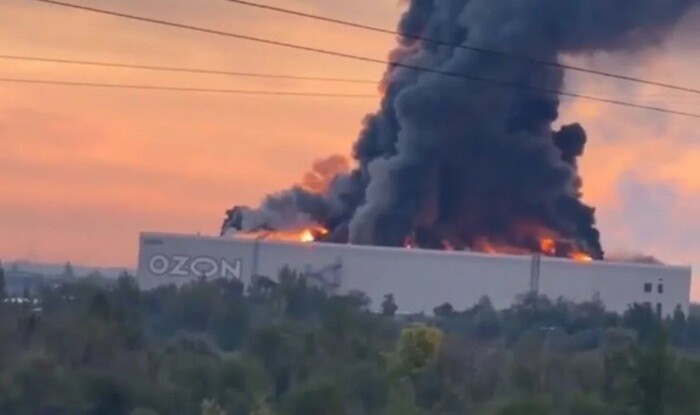
Fire breaks out at Ozon warehouse in Russia - Video
12:51
| Home page Politics |

|

Earlier, Minval Politika published a series of materials featuring video recordings in which former prosecutor of the International Criminal Court, Luis Moreno Ocampo, and his associates effectively expose themselves while discussing a campaign against Azerbaijan. These revelations suggest that the issue is not about “values” or “principles,” but rather a coordinated pressure system involving the Armenian lobby, European politicians, and financial flows linked to Russian-Armenian business circles.
Axar.az reports that Minval Politika has published another piece on the same topic.
Luis Moreno Ocampo directly speaks about his connections in the European Parliament, mentioning the circle around Josep Borrell, and without any hesitation describes mechanisms of influence over EU decision-making — including pressure on the European Commission. At the same time, the financial structure is also being exposed: initially, funding came from Armenian sources, and later a group of wealthy diaspora sponsors was involved, mainly based in Russia. Among them, according to our data, are Samvel Karapetyan and Ruben Vardanyan. The key principle is anonymity and the use of closed financial schemes.
Moreover, certain segments directly point to interference in Armenia’s internal processes — including discussions of possible regime change scenarios. Ultimately, what is presented here is not merely lobbying, but a multi-layered operation: media, political, and financial, aimed against Baku and simultaneously undermining regional stability.
Last week, the editorial team of Minval Politika sent official inquiries to European institutions, including the European Parliament, requesting clarification on possible links between Luis Moreno Ocampo and European bodies, as well as his circle around Josep Borrell. The requests also asked whether any checks or investigations had been launched into potential lobbying, conflicts of interest, or corruption risks identified in the video materials. The questions further included whether the European Parliament was prepared to initiate an official inquiry.
A reasonable amount of time has passed, yet no response has been received. The editorial team of Minval Politika interprets this silence as telling: in Brussels, they are clearly aware of what is being referred to, but prefer not to comment.
The same European institutions that typically react swiftly to any issue involving Azerbaijan have, in this case, taken a noticeably cautious stance. A follow-up request will be sent in the hope of obtaining at least some official response — or confirmation that there is simply no comment to be made.
Today, Minval Politika presents new video footage that further strips away the mask of Luis Moreno Ocampo.
Luis Moreno Ocampo said: “The next step for me is to see how to organize this on an artificial intelligence platform and do it properly. That’s why I’m working with the University of Sao Paulo, at the Faculty of Physics, on a project related to artificial intelligence. I recently spent a few days in Spain with friends who are involved in companies of this kind. We discussed how the Armenian project is a pilot for a company using artificial intelligence.”
Luis Moreno Ocampo added: “If we talk about this… it’s something completely different. I don’t want to alarm you, but I’m involved in many things. I’m also a professor at the University of Sao Paulo in Brazil. I work with a physicist in the field of physics. We mainly use modern physics and artificial intelligence to model and try to understand global order and global disorder. Brazil is funding this work. We have supercomputers running these models. At first, we focused broadly on global order. Then we said: ‘no, that’s too complex — let’s focus on genocide.’ And then we said: ‘let’s focus on Nagorno-Karabakh,’ because I have a lot of data on it. We’re working on Nagorno-Karabakh. I see it now as an academic product, an academic project, and I need to get the most out of it. So I’m trying to build a cross-border company that turns the information we generate into something that reaches decision-makers. It should reach mainstream media and social networks to gain visibility. It should also reach other scientists to make it solid and established.”
Unknown interlocutor: “But are you developing a program using artificial intelligence?”
Luis Moreno Ocampo: “Yes, yes.”
Unknown interlocutor: “Because there are already programs and think tanks that come together to advise decision-makers — this has existed for a long time.”
Luis Moreno Ocampo: “Yes, yes.”
In the recordings obtained by Minval, Luis Moreno Ocampo no longer appears to conceal his intention to take his activities to a new level through the use of artificial intelligence. This, according to the materials, involves building an entire infrastructure of influence in which an “academic project” is effectively transformed into a tool for exerting pressure on politicians, media, and international institutions.
Luis Moreno Ocampo speaks openly about his collaboration with the University of Sao Paulo, the use of supercomputers, and efforts to model a “global order” with the help of AI. More notably, he directly identifies Karabakh as one of the key areas of focus, stressing that he views it as a “product” from which maximum value should be extracted.
He goes further, speaking about the creation of a cross-border company designed to turn “produced information” into a tool for influencing decision-makers, promoting selected narratives through the media, social networks, and expert communities.
In essence, this is presented as an attempt to industrialize information and political influence efforts—framing them within an “academic” structure and scaling them through technology.
Luis Moreno Ocampo himself makes it clear that the system he is building is not an abstract theory but a concrete tool. According to the recordings, the program is designed to channel campaigns against Azerbaijan related to Karabakh through specially created platforms, delivering them directly to decision-makers in international institutions and academic circles, shaping the narrative and cementing it as an “expert position.”
In practice, this is presented as a large-scale influence apparatus targeting Baku, involving deepfakes and other technological tools of manipulation.
In other words, what is described is no longer just lobbying, but the architecture of a hybrid operation, openly outlining how pressure on states is constructed and scaled—from social media all the way to the offices of European officials.


|
Date
2026.05.04 / 10:35
|
Author
Axar.az
|