Extreme heat sets new record across Ukraine
23:13
| Home page World |

|
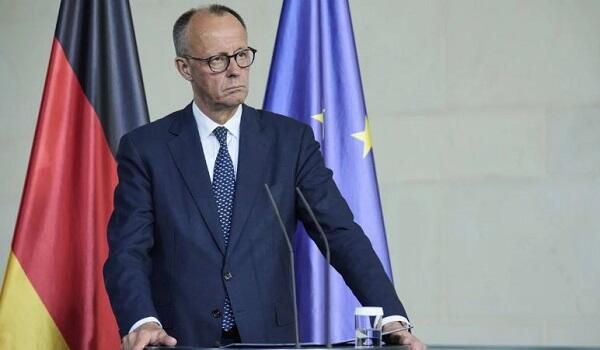
German Chancellor Friedrich Merz believes that the coming year 2026 could be decisive for both his country and Europe as a whole.
Axar.az reports that this was stated in his first New Year's address to the nation as head of government, the text of which was distributed by the German cabinet press service.
According to the Chancellor, 2026 "could be a decisive year" for Germany and Europe. "It could be the year in which Germany and Europe re-emerge with renewed vigor into decades of peace, freedom, and prosperity," Merz noted. He believes the coming year could be a "breakthrough moment." The Chancellor noted that "the world is changing rapidly" and that these changes affect everyone. Among the main challenges facing his country, he cited the conflict in Ukraine, which, according to the head of government, "directly threatens the freedom and security" of Germany.
The Chancellor also noted that the German economy is "under pressure from necessary reforms, high costs, and international trade conflicts." "We are seeing a return to protectionism in the global economy. Our strategic dependence on raw materials is increasingly being used as a political lever against our interests," he noted, noting that geopolitical changes are significantly impacting Germany's prosperity. "As an export-oriented country, we are particularly sensitive to this," the head of government acknowledged. Merz believes that the lack of progress in reform implementation is paralyzing the potential of German companies. "It is increasingly difficult for them to survive in the face of international competition," he emphasized.
Merz noted that the nature of relations with the United States, "which has long been a reliable guarantor of security" for Europe, is simultaneously changing. "For us Europeans, this means we must defend and uphold our interests even more strongly with our own efforts," he said.
"All these events show that we are living in a period of epochal change," the Chancellor noted, emphasizing that Germans are capable of overcoming all challenges themselves. "I recognize that many citizens, in the face of uncertainty, are living in anxiety about the world. I tell you: we will take care of our security. We live in a safe country. To ensure that this remains the case, we must improve our deterrence capabilities. We want to be able to defend ourselves so that we do not have to defend ourselves," the statement reads.


|
Date
2025.12.31 / 13:14
|
Author
Axar.az
|