
Putin orders increase in size of Russian army
10:50
| Home page World |

|
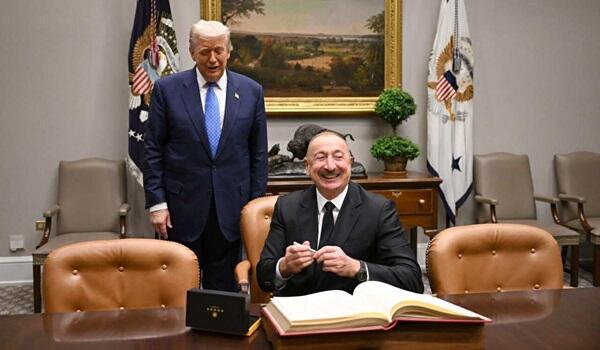
President Donald Trump will soon have to decide on Iran as a U.S. aircraft carrier strike group arrives in the Middle East this weekend. But first, he must clarify this question: Is Iran a multinational country or an empire under Persian rule? Even Iranians cannot give a coherent answer to this question.
Axar.az reports that Michael Doran, director of the Center for Near East Peace and Security at Hudson University, said this in an article he wrote for the Washington Post.
“Yugoslavia had long presented itself as a pluralistic, multi-ethnic state, and it was accepted as such. Many Yugoslavs shared this identity wholeheartedly. But when the regime collapsed in the early 1990s, this identity disappeared almost overnight. People who called themselves Yugoslavs woke up in the morning as Serbs, Croats, or Bosniaks. Long-suppressed ethnic identities were revealed, and politics turned violent.
In Yugoslavia, the dominant Serbs made up about 36% of the population. In Iran, Persians, although of great importance, are still almost a minority. According to a 2010 study by the Iranian government, their ethnic share is 47%. Iran’s ethnic geography further exacerbates the situation. Persians predominate in the centers around Tehran and Isfahan. The minorities, however, are concentrated along the border, or rather on both sides, and share language, culture, and history with communities on the other side of the border. "Azerbaijanis are concentrated in the northwest, along the borders of Azerbaijan and Turkiye, Kurds in the west face the Kurdish regions of Iraq and Turkiye, Arabs in the oil-rich southwest look to Iraq, Baloch in the southeast maintain contact with their relatives in Pakistan and Afghanistan, and Turkmen in the north border Turkmenistan. And among these neighbors, one neighbor is more important than the others - Azerbaijan," the article said.
The author emphasized that the number of ethnic Azerbaijanis living in Iran is larger than that in Azerbaijan itself:
“According to Iranian government research, Azerbaijanis constitute about 23% of Iran’s population (the actual figure may be higher) and are geographically concentrated in a region close to Azerbaijan. Although Azerbaijanis are better integrated into the Iranian state than other minority groups, signs of discontent are growing. They are increasingly reading Turkish and Azerbaijani media, showing greater interest in their Turkish-Azerbaijani roots, and demanding education in their native languages. It is not difficult to understand why. Turkiye and Azerbaijan are developing at a European level. However, Iran suffers from economic collapse and isolation. When Iran was re-established during the 1979 revolution, Azerbaijan was part of the Soviet Union. After independence, it became weak, fought a war with Armenia, and did not significantly affect Iran’s internal balance. Today, however, the situation has changed. Today, Azerbaijan is a rising regional power with a NATO-level army, deep ties with Turkey, and a close security partnership with Israel. If a violent internal conflict breaks out in Iran, Azerbaijan, with the support of Turkiye, will be able to protect its compatriots may have to intervene to protect its compatriots.
Ethnic fragmentation in Iran is not inevitable. It is a real possibility, and Washington cannot ignore it. The best course of action is not to speculate one way or the other about Iran’s future if the current regime collapses. For American policymakers, investing in a stable and centralized Iran can be as risky as investing in its fragmentation. This is important now because there is a growing movement in Washington and among parts of the Iranian diaspora to recognize Reza Pahlavi, the son of the Shah of Iran, who was overthrown in 1979, as the representative of the Iranian nation. He is popular, but his legitimacy is questionable. Many members of Iran’s ethnic minorities see him more as a symbol of Persian chauvinism than national unity, and Iranian Azerbaijanis are no exception. In recent weeks, Azerbaijanis have repeatedly shared with me a scenario that worries them. In this scenario, Ayatollah Ali Khamenei is overthrown, but the system remains in place. The IRGC goes through a transition period, loses its spiritual cover, and re-emerges as the executors of a Persian nationalist dictatorship—potentially. He sees Pahlavi as a symbolic figurehead. Still, he retains real power behind the scenes.
A Pahlavi-Khamenei exchange would seem attractive to Washington: ending the nuclear program and showing moderation without the chaos of regime change. But for Iran’s minorities, it would be seen at best as a continuation of the regime, and perhaps a darker one. A government that relies on Persian nationalism for legitimacy could soon become even more repressive. Whether Iran is a multi-ethnic country or a Persian empire is still unclear, and it will remain so until events force it to rethink its position.
Trump’s next steps—whether attacks, sanctions, or negotiations—could accelerate this process. Washington is committed to supporting Iranians of all ethnic groups.
"He should consult widely with the leaders of neighboring countries, especially President Ilham Aliyev, who will have to deal with the consequences of the coming crisis in Baku. But above all, Trump should resist appointing successors in Iran and build his policy for uncertainty, not stability. This will be a confusing time."


|
Date
2026.01.26 / 23:15
|
Author
Axar.az
|