



Man injured in landmine blast in Shusha
19:32
| Home page Society |

|
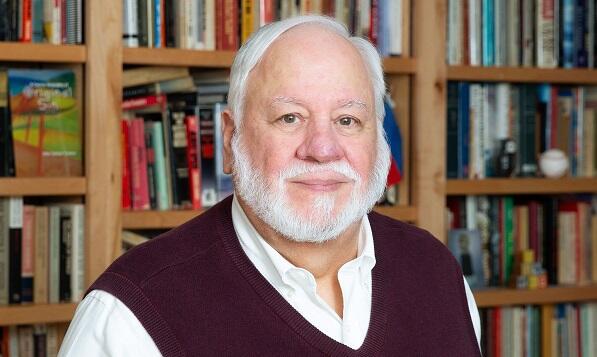
Axar.az presents an article, "A Small Summa" by John Samuel Tieman.
I
I believe in a love that sails the Caribbean in a honeymoon yacht. But just now, just this day, Sunday at age seventy-six, this morning, I have come to believe in a love that begins when my wife gently awakens me. I have come to believe that God is in her hand. In the hand that caresses my shoulder in the morning. The hand that encourages me to open my eyes.
II
I can't prove there is a good and loving God. But sometimes, just sometimes, just for a moment, there's this glimpse – When I despair, when I read that an immigrant is arrested for being brown, when there's another war, when I hear of an old friend diagnosed with cancer –
Then a goldfinch lands on my sill – on the radio, a flute plays “Kojo No Tsuki” – while holding hands, an elderly couple walks by – and I remember all the love –
And I remember how my little stream will flow to the river which will flow to the gulf which will flow to the ocean which will all evaporate –
And for a moment, just for a moment, there's this loving presence reminding me of the oneness that is the good.
Soon, I'll read the newspaper, read of a shooting in East St. Louis, and again I'll despair. I can prove nothing, and I'm a little mad about that. Then just now, on the radio, for the next minutes, I listen to Smetana's “Vlatava”. And I think how this tormented man so loved his home that he turned its river into an orchestra. And I remember all the love. And the stream begins as the flute. And there, just for the one moment, I don't care what I can prove.
III
How often today is there shared meaning, shared experience, shared sensibility when someone uses terms like God, blessing, “consider the lilies of the field”? Religion is not dead. God is not dead. Charity is not dead. But, without a working vocabulary, without a shared sense of meaning, religion could be dying. After all, in the beginning was the word. But what if there is the end of meaning? That end is not to sit alone in silence – this end is to walk the streets of Babel.
IV
"Beauty is truth, truth beauty”, the poet says. The beautiful word does not simply entertain. It changes a person. The words matter. “I, John, take you, Phoebe, to be my wife.” Those simple words changed my life. I also love the lyricism of a gospel portion I heard as an altar boy. “In principio erat Verbum, et Verbum erat apud Deum, et Deus erat Verbum.”
The experience of God is the experience of limitless belonging. It's what makes white Christian nationalism so dangerous and, in the end, meaningless. Mysticism, at its most fundamental, is the experience of oneness. Such a sense leads to acting as one acts when one feels a sense of belonging, the deepest sense, the most profound sense of belonging.
This is not without its political implications. Because every moral and ethical system – in our case, the democratic republic – is based upon belonging. Belonging is about love, and love is about hope. For what do we hope? For “a more perfect union”. I'm not talking about a utopia. I am talking about the neighborhood.
V
Take God, for example. When I was young, I could touch God. The God of my youth was bland granite with eyes chiseled open and blind.
But first thing this morning, I found God in the indolence of darkness.
I use the terms “God” and “love” interchangeably. But these concepts I merely ponder. As for belief, I believe in acts of love. I believe that God asks me to fill the empty hand of the beggar. I sit on my city council, and my job is to listen to the love in true civic dialogue. I believe that I find God as I type the poem, the one I begin without knowing where it will end.
I can tell you what I believe. But I’ve reached an age where I don’t care what I believe. Because I believe that love is not found in the mind or the heart. Love is found in the hands. Love is in the nightly back scratch I give my wife. My wife kneading dough, that’s love. Love is in the hand that crafts, sculpts, sews, caresses, soothes.
That’s where God is. That’s where God is the most obvious. In the hands. In my religion, Roman Catholicism, the hands of the priest are especially dedicated during his ordination. If I could, I would sanctify the hands of everyone. I would bless the hands of the nun who teaches the child to write. I would bless the hands of my wife as she emails to me a joke. I would sanctify the hands of the clarinetist as she plays the Mozart concerto. I would consecrate the hands of the carpenter who shaped our simple dinner table. I would bless the hands of our dinner guests.
I believe in a love that sails the Caribbean in a honeymoon yacht. But just now, just this day, Sunday at age seventy-six, this morning, I have come to believe in a love that begins when my wife gently awakens me. Because God is in her hand. In the hand that caresses my shoulder in the morning. The hand that encourages me, simply, to open my eyes.


|
Date
2026.03.16 / 09:52
|
Author
Axar.az
|