




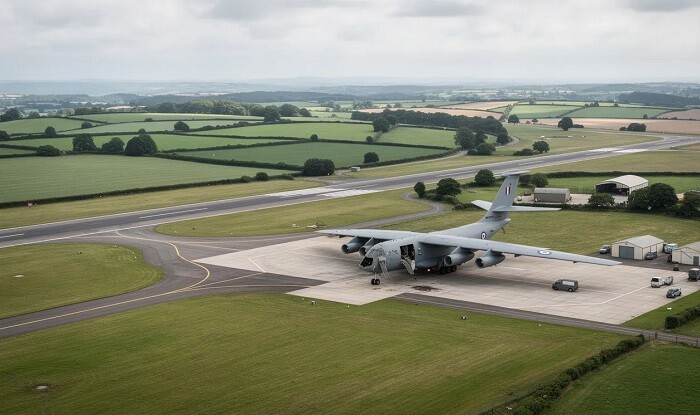
UK police question five men held at airbase used by US
15:34
| Home page Society |

|
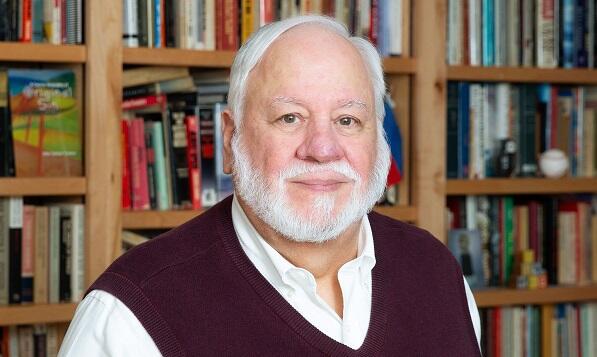
Axar.az presents an article, "Shaking Hands " by John Samuel Tieman.
I keep thinking about what the bishop said. A “new era of martyrdom”. He said that. A “new era of martyrdom.” The Episcopal Bishop of New Hampshire, Rob Hirschfeld, mourned the death of Renee Good, who was shot by an I.C.E. agent in Minneapolis on January 7. “I have told the clergy of the Episcopal Diocese of New Hampshire that we may be entering into that same witness, and I’ve asked them to get their affairs in order, to make sure they have their wills written,” Hirschfeld said. “Now is no longer the time for statements, but for us, with our bodies, to stand between the powers of this world and the most vulnerable.” The bishop used the example of an Episcopal seminarian, Jonathan Daniels. In 1965, Daniels, who was white, was shot by a racist. He died while he was defending a Black woman.
So what does that mean today to a Catholic like me? Sure, it means St. Thomas More. But just now, here in St. Louis in 2026, it means Stanley Rother. Stanley Rother is the first U.S. martyr. He was beatified on 23 September 2017.
Rother was an Oklahoma farm boy born in 1935. He felt called to the priesthood. At first, he did poorly in seminary. I bet, like many young people, he suffered a certain role confusion. In any case, he worked it out and was ordained in 1963. He first served in Oklahoma, then he went to Guatemala. His parish was caught in a civil war.
In 1968, Stanley Rother arrived at a 500-year-old parish in Guatemala. He revitalized the area. But his tools were not some grand plan. He gave the village, Santiago Atitlán, a central organizing principle, The Church. He gave them “faith, hope, and love – and the greatest of these is love.”
He became an accidental social worker. A farmer, he helped the “campesinos” increase crop production. He set up a program that allowed the peasants to buy the land they till. He began a literacy campaign. He started a radio station that gave lessons in reading, writing, and human rights. His clinic, with its nutrition center, lowered child mortality by half.
He translated the New Testament into Tz'utujil, the local Mayan dialect. He celebrated the Mass in Tz'utujil, and he incorporated local customs into the ritual. He encouraged catechists to meet in the homes of parishioners. He showed little interest in liberation theology. That said, circumstances simply compelled him toward the liberation of the politically oppressed, the economically enslaved.
The rebels did, in fact, come to the village once. They lectured the people. Once. Once.
Then the Guatemalan army came to town. They stayed for ten years. They formed masked death squads. The army looted. They raped women. Catechists were murdered. Father Rother publicly denounced the army's death squads. He protected those targeted. He set up funds for their widows, widowers, orphans. He buried the murdered, despite the army's explicit command to let the corpses rot where they lay. In a letter he wrote, “Shaking hands with an Indian has become a political act.”
In January of 1981, when his name appeared on a hit list, he at first returned to the United States. He prayed. One thinks of The Agony In The Garden. Then he returned to Guatemala, this despite universal advice to the contrary. He stood with the “campesinos”. Just after midnight on the 28th of July, with two bullets to the head, Stanley Francis Rother, Padre Francisco, was martyred.
The U. S. government knew of the repression of these indigenous peasants. It did nothing to stop it, and much to facilitate it. State terrorism eventually destroyed at least 440 Mayan villages. In total, about 200,000 people died, and at least 100,000 women were raped during the repression. 66,000 of the dead were indigenous. 34,000 were of mixed race.
On 1 December 2016, Pope Francis confirmed that this man had been martyred "in odium fidei", in hatred of the faith. This assured that Father Rother would become Blessed Stanley.
Beatification is the honor just before canonization. It is easy to think of this person as a celestial second-stringer. However, beatification is a profound honor unto itself. Parishes and schools will be named after him. His feast day is celebrated on July 28th. His relics are venerated. He is assigned iconography.
And here's why all this is important. Like Guatemala in 1981, we live in an age in which racist cruelty has become public policy. By beatifying Stanley Rother, the Church counters that cruelty with an example of love. It declares, simply, look at this guy – this is the way a Christian acts. When we argue in favor of kindness to immigrants and people of color, think of Blessed Stanley saying, “Shaking hands with an Indian has become a political act.”
What does his story mean to us today? When the bishop calls for “a new era of martyrdom”, he's not calling for a new blood bath. The story of Stanley Rother is a story of love. The love is what endures. Every year, on July 28th, the name Stanley Francis Rother will be said aloud. He will be called Blessed. His love of an indigenous people will be celebrated. His life will be used to illustrate the text, “Greater love hath no man than this, that a man lay down his life for his friends.” And this, this love, his love, his love will not fall out of history. When we make his love our love, that's when Rother's story has meaning.
To borrow from the Good Book, he fought the good fight, he earned a crown of righteousness. The Church stands in awe that this man ever existed. But we stand in awe not of his day-to-day deeds. What he did, these tasks are not awesome. That's the point. These are not tasks beyond any of us. He joined folks tilling their fields.
We stand in awe of his love. Because here's the simplest task: Stanley Rother reached out to shake the hand of someone brown. So may we all.


|
Date
2026.03.30 / 09:52
|
Author
Axar.az
|





.jpg)