



Romania proposes joint NATO military command in Black Sea
09:37
| Home page Science |

|
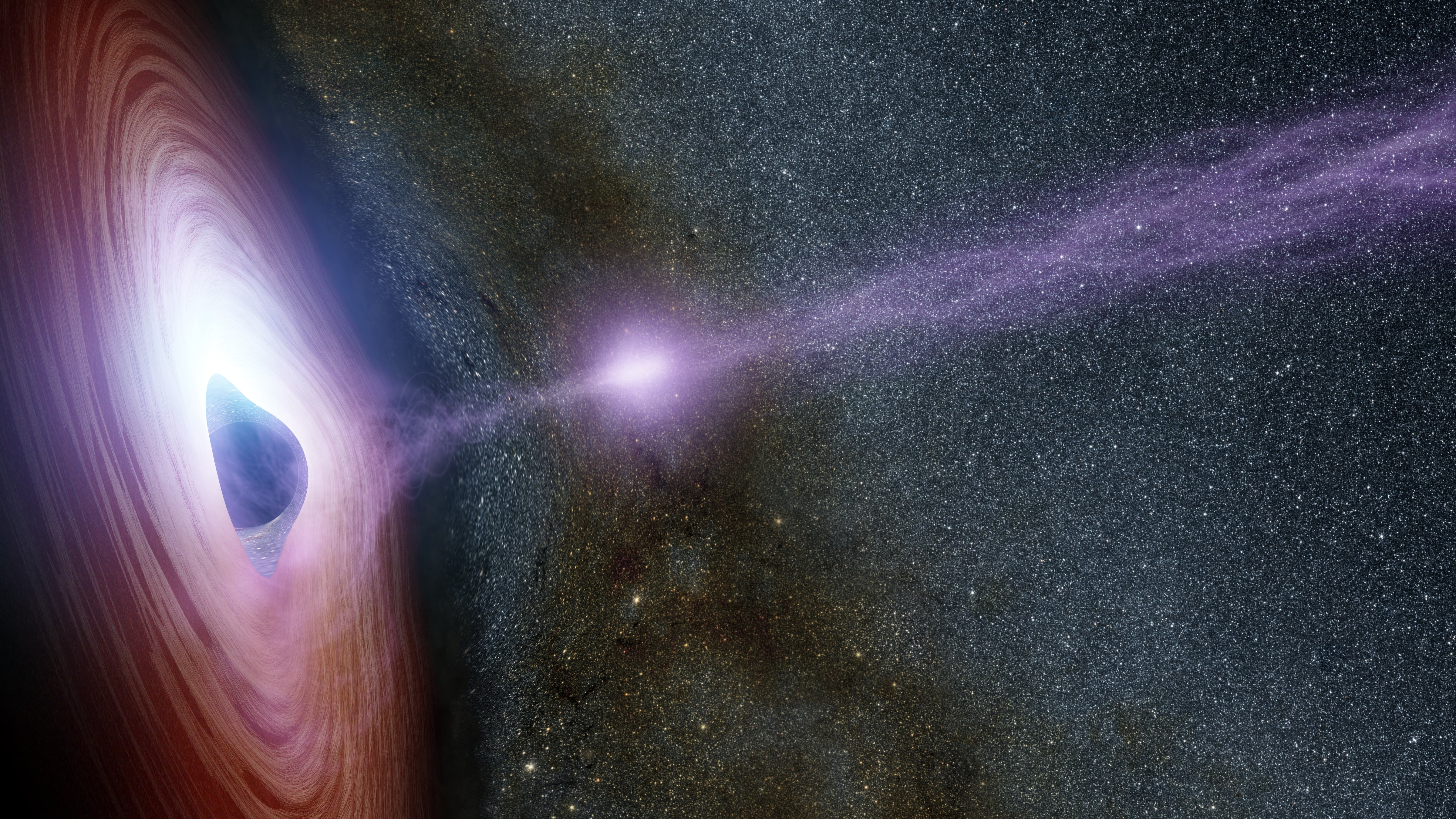
Astronomers may have identified one of the most compelling candidates yet for a pair of supermassive black holes locked in a late-stage orbital dance inside a single galaxy.
Axar.az reports the system, located in the active galaxy Markarian 501 about 500 million light-years from Earth, appears to show unusual radio signals consistent with two separate black holes each producing its own jet of high-energy particles.
Researchers suggest these two black holes, each with a mass up to a billion times that of the Sun, could be orbiting each other every 121 days and may merge in as little as a century.
The discovery is based on more than two decades of radio observations from the Very Long Baseline Array, which revealed unexpected patterns in the galaxy’s core. Initially, scientists tracked a single jet, but higher-frequency data revealed a second, differently oriented signal, suggesting the presence of another jet from a second black hole. Periodic variations in brightness further strengthened the hypothesis that the system is binary in nature, although researchers caution that the interpretation remains uncertain.
If confirmed, the system would represent a rare glimpse of the final stage of galactic mergers, a process where two central black holes gradually spiral inward after their host galaxies collide. While such mergers are expected to be common across the universe, they are extremely difficult to observe directly because the black holes are too close together to resolve with current telescopes. Instead, astronomers rely on indirect signals such as periodic radio variations and jet behavior.
The potential binary could also offer a unique opportunity to study gravitational waves produced by supermassive black hole collisions. Scientists believe that if the system is as close to merging as estimated, its orbital period should shorten measurably within the next decade, providing a rare chance to confirm its nature. However, experts remain cautious, noting that previous candidate binaries have often failed to hold up under further scrutiny.
If validated, the discovery would not only confirm a long-theorized stage of galaxy evolution but also suggest that such tightly bound black hole pairs may be more common than previously thought—raising new questions about how frequently these cosmic giants collide across the universe.


|
Date
2026.04.10 / 23:23
|
Author
Axar.az
|