








Five men bailed after arrests near US-run UK air base
28 September 23:58
| Home page Politics |

|
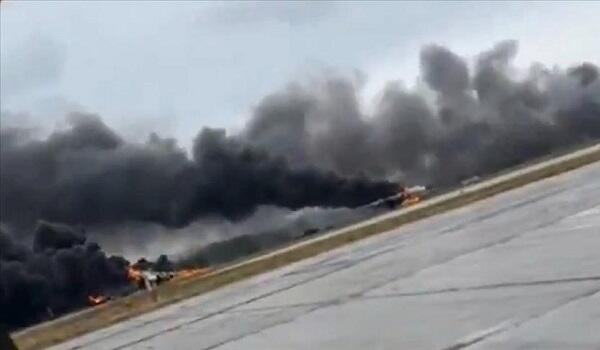
Today’s crash of Iranian drones at Nakhchivan International Airport raises a key question: was it a deliberate attack, or a miscalculation, or simply an error?
Axar.az reports Iran has been facing an unprecedented wave of attacks since February 28. The country’s command structure, including senior leadership figures, was reportedly struck in the early stages, after which the strikes intensified. With each passing day, the scale of the attacks has continued to grow.
In response, Iran has launched strikes on Gulf countries, describing them as operations targeting “the U.S. military presence in the region.” However, the targeting of oil facilities, energy infrastructure, and air and sea ports in Arab states appears to have little direct connection to U.S. bases.
Iran may argue that Gulf countries opened their airspace to Israeli and U.S. forces and therefore became participants in the conflict, even if indirectly. But how can yesterday’s ballistic missile incident involving Turkiye and today’s drone strike on Nakhchivan Airport be explained?
Western media reported yesterday that an Iranian ballistic missile was heading toward a “U.S. base in Turkiye.” Iran, however, denied targeting any facility in the country. Still, Tehran could attempt to offer its own interpretation of the missile incident.
Why might Azerbaijan be affected? Could the drones have strayed from their intended targets? Was it simply a mistake? Or did the drones cross the border while flying in another direction and get shot down by air defense systems, with the damage caused by falling debris?
Let us start with the last question. Watch this video:
It is clearly visible that this is not a case of a drone being shot down or debris falling into the area — the UAV is directly carrying out an attack. Moreover, the drone strikes the area near a school located close to Nakhchivan International Airport.
This means we should be talking about an attack.
Could the drones have missed their intended targets and gone out of control?
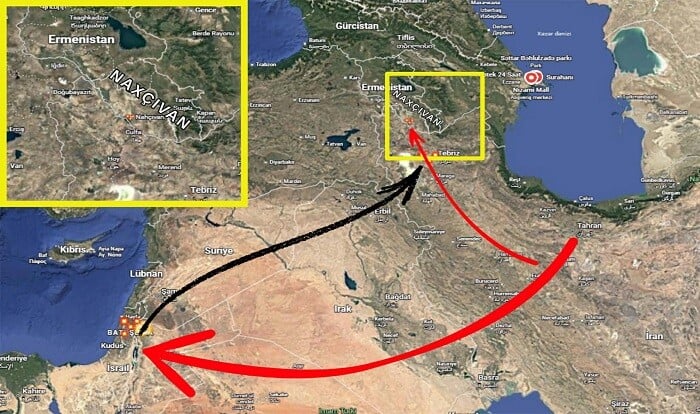
Take a look at the maps:
1.Israel and the United States are attacking Iran from the Gulf and through the airspace of Arab countries. The northwestern part of Iran bordering Azerbaijan lies to the east of a long border with Türkiye, which stretches for 534 kilometers. Since no attacks on Iran have been carried out from Turkish airspace, Iran’s defensive and offensive operations should be taking place at least 300–400 kilometers south of the Azerbaijani border.
2. In northwestern Iran, Israel and the United States have targeted only military facilities in Tabriz and Urmia. As can be seen on the map, the distance from Tabriz and Urmia to the Azerbaijani border is more than 200 kilometers.
The drones that fell in Nakhchivan were attack UAVs. What are such attack drones doing near Iran’s northwestern border?
3. During the Second Karabakh War, there were also incidents in which artillery shells from both Azerbaijan and Armenia fell into Iranian territory. However, those incidents were immediately described as accidental and apologies were issued, even though Iran strongly condemned the situation and issued sharp warnings to Azerbaijan.
Now, however, there has been no denial and no immediate explanation.
4. If this really was some kind of accident or mistake — if attack drones flying near the Azerbaijani border somehow strayed off course — why did they head specifically toward strategic infrastructure, namely an international airport?
5. How is it that two drones crossed the border at the same time by “accident” and both ended up striking the airport?
6. Why did Iranian drones lose “control” specifically near Nakhchivan Airport? And why didn’t one of these drones “accidentally” cross into Armenia instead?
7. Telegram channels close to the IRGC have circulated the news with the following message: “We attacked Azerbaijan.”
There cannot be this many “coincidences,” and the IRGC-linked channels appear to be telling the truth.
This was an attack indeed!


|
Date
2026.03.05 / 14:50
|
Author
Axar.az
|