


Estonia moves bill limiting Russians’ property purchases
21:33
| Home page Science |

|
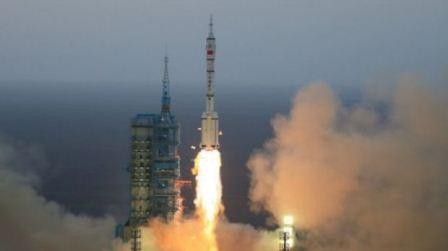
China has sent two astronauts into space on a mission to dock with an experimental space station and remain aboard for 30 days in preparation for the start of operations in six years.
The Shenzhou 11 mission took off from the Jiuquan Satellite Launch Center on the edge of the Gobi Desert in northern China at 7:30am (2330 GMT) aboard a Long March-2F carrier rocket.
It will dock with the Tiangong 2 space station precursor facility within two days, conduct experiments in medicine and various space-related technologies, and test systems and processes in preparation for the launching of the station’s core module in 2018.
Following the attachment of two experiment modules, the entire station is designed to begin full operations in 2022 and will operate for at least a decade.
Space program commander-in-chief Gen. Zhang Youxia declared the launch a success at 7:46am (2346 GMT).
Fan Changlong, the defence minister, then read a congratulatory message from President Xi Jinping calling for China’s astronauts to explore space “more deeply and more broadly.”
Premier Li Keqiang and propaganda chief Liu Yunshan visited the Beijing control centre to congratulate staff. It is the sixth time China has launched astronauts into space.
An earlier Tiangong 1 experimental space station launched in 2011 went out of service in March after docking with three visiting spacecraft and extending its mission for two years. The Tiangong, or “Heavenly Palace,” stations are considered stepping stones to a mission to Mars by the end of the decade.
The Shenzhou 11 astronauts are Jing Haipeng, who is flying his third mission, and 37-year-old Chen Dong.
“It is any astronaut’s dream and pursuit to be able to perform many space missions,” Jing, who turns 50 during his time in space, told a briefing Sunday.
China conducted its first crewed space mission in 2003, becoming only the third country after Russia and the US to do so, and has since staged a spacewalk and landed its Yutu rover on the moon. Administrators suggest a crewed landing on the moon may also be in the program’s future.
China was prevented from participating in the International Space Station, mainly due to US concerns over the Chinese space program’s strongly military character. Chinese officials are now looking to internationalize their own program by offering to help finance other countries’ missions to Tiangong 2.
China’s space program also opened its massive fourth spacecraft launch site at Wenchang on China’s southernmost island province of Hainan in June. It was inaugurated with the launch of the newly developed Long March 7 rocket that was hailed as a breakthrough in the use of safer, more environmentally friendly fuels.
China is currently developing the Long March 5 heavy-lift rocket needed to launch the Tiangong 2’s additional components and other massive payloads.
China also plans to land a rover on Mars by 2020, attempting to recreate the success of the US Viking 1 mission that landed a rover on the planet four decades ago.
A source of enormous national pride, China’s space program plans a total of 20 missions this year at a time when the US and other countries’ programs are seeking new roles.


|
Date
2016.10.17 / 10:45
|
Author
Valeh Mammadli
|