



Azerbaijan marks 6 years since Khudafarin Bridge liberation
09:12
| Home page Society |

|
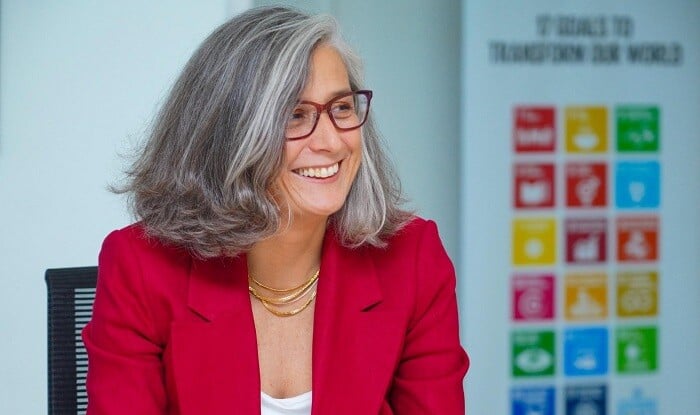
The 13th session of the World Urban Forum (WUF13), to be held in Baku from May 17 through May 22, would be the moment to build the political consensus needed to carry the New Urban Agenda forward.
Axar.az reports that UN-Habitat Executive Director Anaclaudia Rossbach made the remarks, speaking to Trеnd on the sidelines of the ITF Summit in Leipzig.
"Ministers are coming together, and there will be a summary of their discussions that we hope will be fed into the political discussions in New York. The stakeholders are also coming together, and there will be a call to action from Baku that is expected to be fed into those discussions as well," she added.
Rossbach described the upcoming World Urban Forum in Baku as a critical political staging post ahead of the July midterm review of the New Urban Agenda at the United Nations in New York. She said the co-facilitators of that review process would travel to Baku in person — a signal of the meeting's weight in the global urban policy calendar.
"The President of the General Assembly indicated Poland and Norway as co-facilitators — they are going to be with us in Baku. And I believe also from the ministers, a lot of inputs will be absorbed in the process of thinking and reflecting: what are the priorities for the next ten years? What is it that we can do for the next ten years?" she said.
She explained that the New Urban Agenda, now marking its tenth anniversary, still has a decade to run — and that Baku would be the moment to build the political consensus needed to carry it forward.
"We need to build a consensus, a strong coalition to deal with the challenges of the New Urban Agenda for the next ten years. And this is where this conference fits in," she emphasized.
On Azerbaijan specifically, Rossbach confirmed that UN-Habitat is already actively engaged with the country, with a team and an office in Baku assisting the government on urban planning — including the country's large-scale reconstruction of its recovered territories.
"We have a team, we have an office in Baku, and we are working with the government, actually assisting on urban planning and planning this urban transformation. And indeed, there are interesting stories there in Baku itself — the story of the urban transformation of the White City, and so on," she revealed.
Rossbach explained the unusual format of the World Urban Forum itself. She said it was designed by the General Assembly as a stakeholder engagement mechanism — and has grown into the second largest conference in the UN system, with some 400 partner-led events.
"It's a place where stakeholders come and provide inputs to our work, to our agenda. The majority of the events are partner-led. All the discussions we are going to have are in-depth practices — we share practices together, training, developing capacities, the exhibition. Everything is around housing," she stated.
She said the overarching theme of housing was not chosen arbitrarily. UN-Habitat's new strategic plan for 2026–2029 is built around what she called a global housing crisis — spanning access to housing and land, basic services, and the transformation of informal settlements — and has been endorsed by 105 member states.
"Cities are the front lines of many, many challenges that we face. We still have Africa and Southeast Asia urbanizing at a very accelerated pace. Two billion people are coming to cities — cities that are lacking a lot of infrastructure."
Asked why she had chosen to appear at a transport-focused summit, Rossbach argued that urban mobility and housing are inseparable systems, and that failing to plan them together produces dysfunction in both.
"Transportation, urban mobility is an intrinsic part of that. Because sometimes transportation goes ahead of housing, sometimes housing goes ahead of transportation — and it doesn't work. We cannot expect to have sustainable mobility if we don't plan right," she added.
She reserved particular urgency for informal settlements, home to roughly one billion people worldwide, calling their persistence "unacceptable" given that the tools and knowledge to upgrade them already exist.
"It's unacceptable that having the know-how to improve slums, to integrate slums in the city, we still have the prevalence of very precarious living conditions around the world. We see that as an emergency agenda to be tackled within the global housing crisis," Rossbach said.
Rossbach also linked informality directly to climate vulnerability, noting that residents of informal settlements are the first to suffer from climate-related disasters — and are routinely left out of urban planning visions, often because they are not even mapped.
"They are usually excluded of the picture, excluded of the vision, because many times they are not even mapped. So there is a strong effort needed on this front as well," she outlined.
On informal transport — raised by a participant drawing on experience in cities like Manila — she described a growing trend, particularly in Latin America, of cities formally recognizing community-led transport solutions that had developed organically.
"There are so many examples of cities, or communities, that have developed their own means of transportation and were then recognized by the mayors as public policy. There's a trend of designing policies, master plans and transportation policies that build on what's there — connecting informal to formal means of transportation," she said.
On urban sprawl, she identified housing itself as its primary driver — land prices pushing social housing to city peripheries, self-built homes expanding into peri-urban areas, gated communities fragmenting the urban fabric — and called for a cultural shift toward densification.
"If you look at urban sprawl, housing is actually the main cause. The New Urban Agenda talks about compact cities, and I believe there are many cities now, many countries, that are incorporating densification in their national urban policies — transport-oriented models like the state of Massachusetts, Japan, Latin American cities. It is a challenge because it requires also a cultural acceptance — that we need to intensify and maximize recycling of the built environment," she highlighted.
She closed by framing the crisis in its broadest terms: a global emergency of affordability that demands comprehensive national strategies tailored to every segment of society.
"It's actually a crisis of affordability, and countries are developing different strategies to deal with that. National strategies cannot be universal because you don't have the resources — but at least they can be comprehensive, and they should be designed for all segments of society," Rossbach concluded.


|
Date
2026.05.16 / 13:21
|
Author
Axar.az
|