











Azerbaijan, Bangladesh sign visa exemption agreement
00:13
| Home page Technology |

|
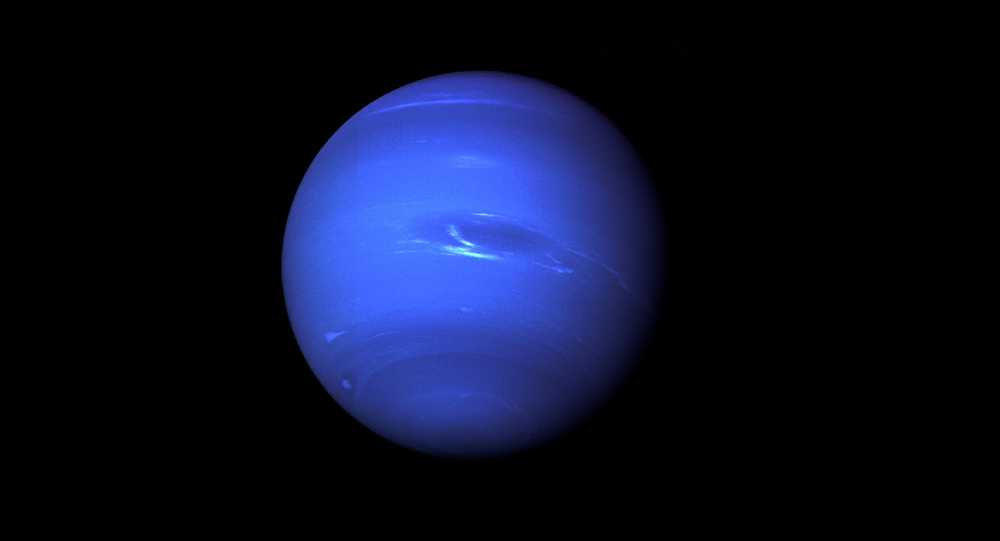
Neptune might not be as gigantic as Jupiter or adorned with the rings like Saturn, but it is well distinguished from all the other planets in our solar system by its incredibly powerful winds, which at times even reach supersonic speeds, according to NASA’s press-release, Axar.az informs.
Neptune’s stormy weather conditions seem to bring about vortices similar to Jupiter’s Great Red Spot, infrequently dubbed as simply GRS. Though storms on Neptune usually last no more than a few years, this time astronomers have managed to witness one of the storms on the planet’s surface evaporate just before the telescope. Incredible, isn’t it?
In 1989, the planet was first approached by NASA Voyager 2, and back then the spacecraft studied Neptune’s anticyclones, which were not that lengthy. Several years later, the Hubble Space Telescope started monitoring the weather conditions on the planet and arrived at some fascinating findings, which could provide the groundwork for more profound climate studies in space.
Storms on Neptune are dark in color due to the specific way in which the planet’s currents operate. There are three dominant wind jets on Neptune: one goes from east to west at the equator, and two others move in the opposite direction close to the planet’s poles.
The anticyclones form between these jets, pulling up darker material from below the clouds. Scientists have made some guesses about how a storm would behave when it dissipated.
According to common earlier assumptions, the vortex was supposed to near the jet stream, then tear apart and possibly produce an explosion of cloud activity, Extremetech wrote.
In reality, which is not that visually impressive, the storm is drifting toward the south pole and slowly dissipating as it comes closer. This is one of the places were Neptune’s winds can reach supersonic speeds. The vortex was 3,100 miles (5,000 km) across when Hubble first spotted it in 2015, and now it’s down to 2,300 miles (3,700 km).


|
Date
2018.02.18 / 23:30
|
Author
Axar.az
|