Nations League second-round matches conclude
01:03
| Home page Politics |

|
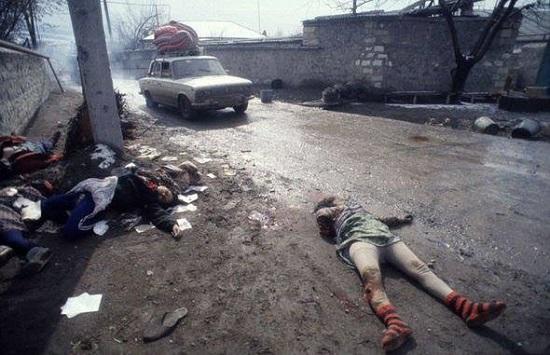
This year commemorates another anniversary of the occupation of Khojaly, Azerbaijan, and the tragic Khojaly genocide, carried out by the Armenian armed forces with the involvement of Russia’s 366th Motor Rifle Regiment.
Axar.az informs that 34 years have now passed since the genocide.
On the night of February 25–26, 1992, Armenian military units, with the assistance of Russia’s 366th Motor Rifle Regiment, attacked the city of Khojaly. Around 2,500 residents of the city attempted to flee toward the direction of Aghdam to save their lives. However, Armenian forces opened fire on the fleeing civilians.
The massacre carried out by Armenian aggressors against the Azerbaijani people claimed the lives of 613 people, including 106 women, 63 children, and 70 elderly individuals. A total of 1,275 civilians were taken hostage, and the fate of 150 of them remains unknown to this day. Another 475 people were left disabled. Eight families were completely annihilated. Twenty-five children lost both parents, and 130 children lost one parent.
In 1994, at the initiative of Azerbaijani President Heydar Aliyev, the Milli Majlis adopted a special resolution titled “On February 26 – Khojaly Genocide Day.” The document detailed the causes of the tragedy and identified those responsible.
A monument titled “Mother’s Cry” has been erected in the Khatai district of Baku in memory of the victims of the Khojaly genocide.
The Heydar Aliyev Foundation continues to carry out systematic and consistent efforts to bring the facts about the Khojaly genocide to the international community. With the Foundation’s support and organization, numerous events, campaigns, exhibitions, and memorial ceremonies are held in various countries around the world within the framework of special projects dedicated to the genocide.
The effectiveness of the “Justice for Khojaly!” campaign, initiated by Leyla Aliyeva — Vice President of the Foundation and Chief Coordinator for Intercultural Dialogue at the Islamic Conference Youth Forum — has increased year by year. The goal of events held within this campaign is to achieve legal and political recognition of the crime committed in Khojaly and to secure international recognition of the Khojaly genocide. Notably, in January 2012, during the 7th session of the Parliamentary Union of the Member States of the Organization of Islamic Cooperation held in Palembang, Indonesia, parliamentary representatives from 51 countries adopted a resolution regarding the recognition of the Khojaly tragedy as genocide at the international level.
The “Justice for Khojaly!” international awareness campaign is currently being successfully implemented in dozens of countries and is aimed at achieving moral as well as political and legal recognition of the tragedy. At present, the parliaments of Pakistan, Mexico, the Czech Republic, Colombia, and Bosnia and Herzegovina, among others, have recognized the Khojaly tragedy as genocide and as an act of crime against Azerbaijan. In addition, the Khojaly genocide has also been recognized by legislative bodies of dozens of U.S. states.
It should be recalled that President Ilham Aliyev, taking into account the importance of the internationally conducted “Justice for Khojaly!” campaign, signed a decree on February 13, 2014, regarding measures for the implementation of the campaign.
Currently, internally displaced persons from Khojaly are temporarily settled in 50 cities and districts across the country.
Thanks to the heroism of the Victorious Azerbaijani Army, the blood of the Khojaly martyrs did not go unavenged. During the 44-day war, the heroic Army, demonstrating unparalleled bravery under the leadership of President and Supreme Commander-in-Chief Ilham Aliyev, avenged the victims of the Khojaly tragedy as well. The city of Khojaly was cleared of separatists as a result of local anti-terror measures conducted by the Azerbaijani Army in Karabakh on September 19–20, 2023. On October 15, 2023, President Ilham Aliyev raised the State Flag of the Republic of Azerbaijan in Khojaly, as well as in Aghdara, Asgaran, Khojavand, and Khankendi.
Representatives of the military junta suspected of involvement in the Khojaly events have been detained and brought to Baku. In their ongoing trial, the Khojaly tragedy is listed as one of the criminal episodes under consideration.


|
Date
2026.02.26 / 00:01
|
Author
Axar.az
|