


Five men bailed after arrests near US-run UK air base
28 September 23:58
| Home page World |

|
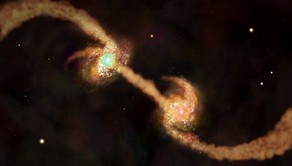
NASA scientists have discovered two dwarf galaxies which after billions of years out in the cosmic wilderness, finally moved into the galactic ‘big city.’
According to the Ria Novosti, this information was stated in the official statement on the site of the organization
The two tiny galaxies, called Pisces A and B, were spotted by Nasa’s Hubble Space Telescope, and astronomers say they likely existed in isolation for most of the universe’s history before more recently entering a region that's dense with intergalactic gas. And, now that they’ve moved into the gas-rich environment, these celestial bodies are set to ignite a ‘firestorm of star birth.’
Each galaxy contains about 10 million stars, and they are both small and faint, making them difficult to detect. The team thinks that gas raining down on them as they moved into the denser region may have triggered star birth. Or, they may have encountered a gaseous filament which compresses gas in the galaxies to facilitate star birth.
‘Studying these and other similar galaxies can provide further clues to dwarf galaxy formation and evolution.’
Being isolated for so long, the researchers say they likely avoided the ‘busy construction period’ that occurred billions of years ago in the early universe, when dwarf galaxies acted as the building blocks for the formation of larger bodies. Researchers say these new observations provide insight on the early days of the universe.
‘These galaxies may have spent most of their history in the void,’ Tollerud explained.
Based on the Hubble observations, the researchers have determined that Pisces A is roughly 19 million light-years from Earth, while Pisces B is about 30 million light-years out. They are both considered to be very young, with observations of 20 to 30 bright blue stars in each indicating that they are less than 100 million years old. Around this same time period, the team estimates the galaxies doubled their star-formation rate, and this may one day slow down again if they become satellites of a larger galaxy.


|
Date
2016.08.13 / 14:40
|
Author
Axar.az
|