







Ukraine envoy thanks Azerbaijan for support to children
19:50
| Home page Health |

|
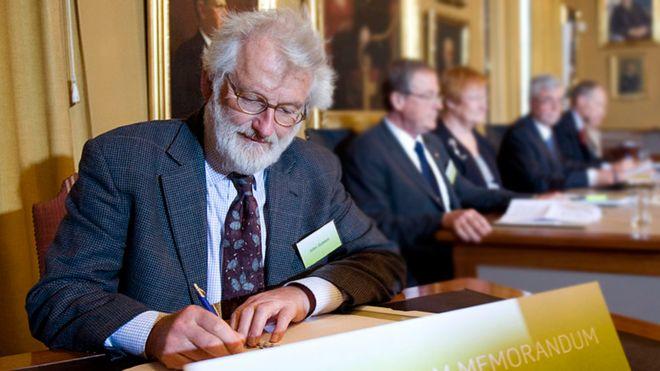
British genome pioneer Sir John Sulston has died aged 75.
He came to prominence as the British face of the international project to decode the human genome.
Sir John won a Nobel Prize in 2002 for his work on the development of cells within a humble worm, which paved the way for innovations in cancer research.
He was known as a passionate believer in pushing the boundaries of science and in making data on the human genome available to all.
He helped found the Wellcome Trust Sanger Institute at Hinxton near Cambridge, and the laboratories there bear his name.
Prof Sir Mike Stratton, director of the Wellcome Sanger Institute, said the scientist had a burning and unrelenting commitment to making genome data open to all without restriction.
"We all feel the loss today of a great scientific visionary and leader who made historic, landmark contributions to knowledge of the living world, and established a mission and agenda that defines 21st century science," he said.
Jeremy Farrar, director of the biomedical research charity, Wellcome, said Prof Sulston's leadership was critical to the Human Genome Project, one of the most important scientific endeavours of the past century.
"His dedication to free access to scientific information was the basis of the open access movement, and helped ensure that the reference human genome sequence was published openly for the benefit of all humanity," he said.
Sir John Sulston will be remembered as one of the greatest scientists of our time. His great adversary was Prof Craig Venter, who led private efforts to sequence and patent human genes, leading to a race between the two. In 2002, Prof Venter hit out at John Sulston, claiming that his efforts had actually held back the development of the technology.
"John wanted to sequence the human genome, I wanted to sequence the human genome," Prof Venter said. "I can't fault him for wanting to do that. But it was more important to him to be the one to do it than to enable it to get done quickly."
Every gene the public sector discovered was a gene that Prof Venter couldn't patent. But Prof Sulston, a proud socialist, said that his efforts were for the public good.
"I suppose I am anti-capitalist to the point that I feel that the companies are completely unnecessary. I think we'd all get on very well if we did all that discovery in universities, frankly.
"I think all the debilitating diseases of Africa and other developing countries cannot be dealt with on a capitalist basis because there is no market - there is no money."
The UK sequenced about a third of the genome, with the US National Institutes of Health (NIH) contributing most of the remainder.
But lobbyists working on behalf of private companies, placed pressure on the Clinton Administration to withdraw funds from the public effort. Prof Sulston's work, sponsored by the Wellcome Trust and the Medical Research Council, strengthened the hand of those arguing for the NIH's continued involvement.
As an individual, Prof Sulston was unassuming, often seen wandering the labs in sandals and chatting with young researchers. We are already benefiting from his research - with the emergence of new medicines for many cancers. We also know the genetic basis of more than 6,000 disorders, allowing treatments to be better tailored.
The revolution that John Sulston helped start has only just begun, and will transform medicine and our understanding of the human body.
Gene race
The son of a vicar, Sir John was born in 1942. He studied for his degree in organic chemistry and PhD in nucleotide chemistry at the University of Cambridge in the 1960s.
After a stint studying in the US, he returned to Cambridge in 1969.
He was recognised with the Nobel Prize in 2002 for his contribution to the understanding of how genes control cell division and death in the nematode worm.
It was a groundbreaking discovery, resulting from three decades of studying the organism.
However, Prof Sulston is perhaps best known for his biggest academic pursuit - spearheading the international project to map the human genome.
The effort became a race between the public and the private sector, which led to a draft being published in 2001.
Both the US President, Bill Clinton, and the British Prime Minister, Tony Blair, spoke at the press conferences held in Washington and London to announce that the draft sequence was complete.
In 2017, Sir John was made a Companion of Honour by the Queen in her birthday honours for his contribution to science and society.


|
Date
2018.03.10 / 13:15
|
Author
Axar.az
|