


Azerbaijani, Turkish FMs discuss bilateral ties in Baku
00:51
| Home page Science |

|
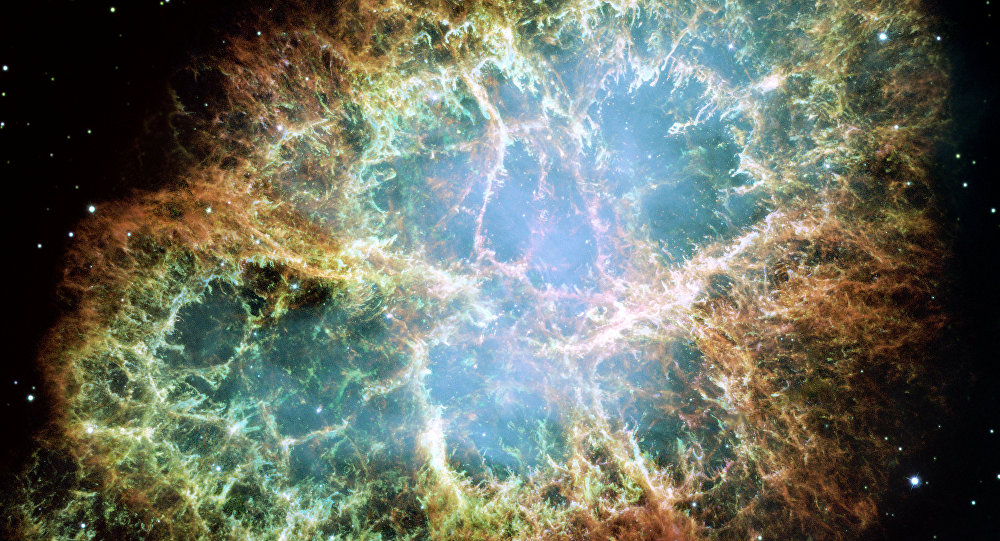
What a couple of babies. Scientists with the University of Colorado have observed the collision of a pair of ‘baby’ protostars that caused a terrifying explosion, reshaping the entire molecular cloud that birthed them.
Axar.az reports that the protostars both formed around 100,000 years ago in a "stellar nursery" in the Orion Molecular Cloud 1 (OMC-1) around 1,500 light-years from Earth. Circa the 16th century, two of these protostars collided and triggered an explosion that scattered the rest of the nursery throughout the cloud. Over the course of a few centuries, the explosion released as much energy as our sun does over 10 million years.
"What we see in this once calm stellar nursery is a cosmic version of a 4th of July fireworks display, with giant streamers rocketing off in all directions," said lead author John Bally, whose team published their findings in the Astrophysical Journal on Friday, in a statement. The observation was done with the Atacama Large Millimeter/submillimeter Array (ALMA) in Chile.
Molecular clouds are the places where stars form, as unfathomable quantities of cosmic dust congregate in one spot. These young stars, still "nursing" from their molecular cloud parent, are known as protostars. They have yet to begin the process of nuclear fusion, and only when they are freed from their molecular cloud and catch fire can they be considered to be true stars.
The OMC is arguably the most famous of these stellar nurseries, as it can be clearly seen in the night sky as part of the Orion constellation.
Astronomers have become more interested in these baby stars in recent years. Previously, they were too small and too dim to study in much detail, particularly because the molecular cloud could block our view of them. As instrumentation improves, studying protostars becomes easier.
"Though fleeting, protostellar explosions may be relatively common," said Bally. "By destroying their parent cloud, as we see in OMC-1, such explosions may also help to regulate the pace of star formation in these giant molecular clouds."


|
Date
2017.04.08 / 10:59
|
Author
Axar.az
|