







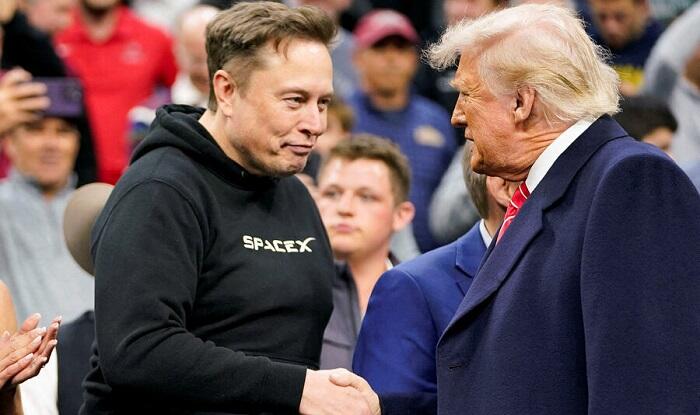
Trump calls flying Tesla Roadster ‘very impressive’
01:13
| Home page Society |

|
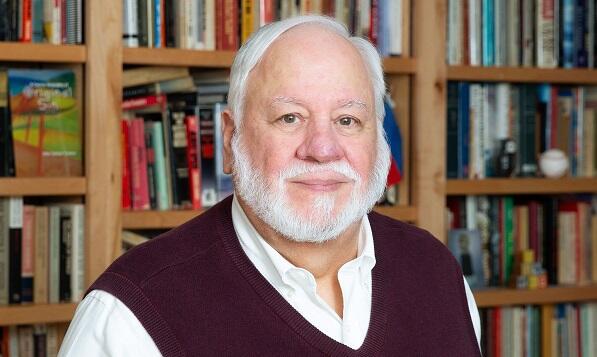
Axar.az presents an article, "Stop Political Violence" by John Samuel Tieman.
There's a meme going around. “Someone should do it.” It's gotten millions of views, likes and forwards. It means someone should assassinate President Trump.
When I was elected to my City Council, I imagined many things. Violence was not one. While I wouldn't call it a frequent topic, when elected officials get together, we talk about it.
Melissa Hortman, a former Speaker Of The House in Minnesota, and her husband, Mark, a state senator, were shot and killed. Here in my home, in a suburb of St. Louis, Kirkwood, just a few miles from my own city hall, a gunman went on a shooting rampage in their city hall. He murdered six people. There have been assassination attempts against President Trump and Governor Shapiro of Pennsylvania. And so much more, this is a litany of horrors familiar to us all. I invoke this litany in order to ask why, why is there so much political violence now?
Robert A. Pape is Professor of Political Science at the University of Chicago. He specializes in security affairs. I heard him interviewed. What follows is a summary of his views about political violence. His views are so insightful that I devote this column to summarizing them.
Prof. Pape feels that “violent populism”, his term, is the biggest risk to American democracy. “The most important fact about political violence in America today is this: tens of millions of Americans, on both sides of the aisle, see political violence as acceptable.” This violent populism pushes volatile folks toward violent activism.
There is more violence now. There is also more acceptance of violence now. During the Biden Administration, about 10% of citizens supported violence to restore Trump to the presidency. Half of that number supported the use of assassination. That's one in twenty people. Since Trump's return to power, that number has grown to between 14 and 21%. 10% find acceptable the murder of Charlie Kirk. 10% also support the attempted murder of Nancy Pelosi. There has been a fivefold increase in threats to members of Congress, left and right. Clearly, Trump's rise was a lightning rod on both sides.
That the president openly encourages his followers to violence: this is no secret. However, there is more going on than just violent speech. There is the impact of social change. Two changes are of special note. First, one of the most important changes is the transition to a white minority. In 1960, 88% of Americans were white. Today, whites make up 55%. In twenty years, that will drop below 50%. Second, there is the shift in wealth to the top 1% from the bottom 99%. Almost nobody is addressing #2.
Many feel a sense of loss. We tend to think of the loss of power as a lower class problem. But the rich and the middle class also see their power ebbing away.
Why would the rich be violent? A woman in a Learjet flew to the January 6th insurrection. A woman in a Learjet? On all sides of the spectrum, the biggest fear is political exclusion. Both sides fear transition. Both sides fear irreversibly, because soon there will be no way to go back. Transition is always scary. It's worth noting that this is not just simply polarization. It's not a policy debate. It's the fear of extinction.
But how do you go from feeling powerless to killing? Words matter. Trump by far has made the most shear numbers of threats of violence. To be fair, some threats have been made by Beto O'Rourke and Gavin Newsom. But the deadly risk factor is the combination of violent speech plus people who are prone to being angry and predisposed to act out impulsively. Such folks are by far the most likely to be activated.
So who are these folks? We want to stereotype such folks as poorly educated, unemployed, unsophisticated, maybe members of a militia and other folks on the fringe. But how do we account for the attorney there on January 6th? Was he the exception? Remember the lady on the Learjet? As Prof. Pape puts it, “We like our monsters to be villains that are far away from us.” The January 6th rioters had a wide range of biographical backgrounds. Physicians, CEO's, teachers -- only 10% were from militia groups, and only 7% were unemployed. We don't like our monsters to be the guy and the gal down the street.
How to reach such folks? We need to address this in two stages. One, address social changes. Political institutions need to catch up. A lot of folks, right and left, address the change in demographics in our country, the change from a white nation to a nation largely made up of folks of color. Hardly anyone, right or left, addresses the wealth shift. Two, we also need leaders, right and left, who jointly condemn the violence. We need to understand that 75% of Americans abhor political violence.


|
Date
2026.05.18 / 09:51
|
Author
Axar.az
|