












Nations League second-round matches conclude
01:03
| Home page Technology |

|
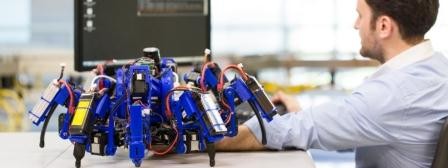
Siemens researchers in Princeton, New Jersey have developed prototype spider-like robots that can work collaboratively to print structures and surfaces, thus potentially accelerating production of large-scale, complex structures such as the fuselages of planes and the hulls of ships.
"To accomplish this, the robots use onboard cameras as well as a laser scanner to interpret their immediate environment. Knowing the range of its 3D-printer arm, each robot autonomously works out which part of an area – regardless of whether the area is flat or curved – it can cover, while other robots use the same technique to cover adjacent areas. By dividing each area into vertical boxes, the robots can work collaboratively to cover even complex geometries in such a way that no box is missed. “No one else has attempted to do this using mobile manufacturing,” says [project leader Hasan Sinan] Bank.
Autonomy is also a central part of other spider behaviors. For instance, the spiders know where they are in a given environment. When its batteries are low after about two hours, a spider will find its way back to a charging station, but not without first transmitting its data to another spider that has just been charged, thus allowing the second spider to pick up exactly where the first one left off. Also, whenever they encounter an obstacle, the spiders autonomously find a path around it.
Right now, the technology is still young, so don’t expect to see any spider-built vessels on the market just yet. Instead, keep an eye on this technology over the next ten years, as it goes from working prototypes to fascinating demonstrations and then finally to mundane, everyday robot swarm.


|
Date
2016.05.02 / 12:54
|
Author
Zumrud Pashkin
|