












Netanyahu warns of possible attacks ahead of Israeli election
20:31
| Home page Culture |

|
A shortlist of six buildings as stylistically different from one another as Britain's St Paul's Cathedral is from Spain's La Sagrada Familia have been announced as finalists for the first RIBA International Prize.
The buildings -- an arts center on an island in the Azores, Portugal; a museum in Mexico; a civic center in Norway; a university in Peru; a cultural center on a former Soviet tank factory in Azerbaijan and a WWI war memorial in France -- were chosen by the Royal Institute of British Architects (RIBA) from a group of 30 architectural projects scattered across five continents.
Although very different in terms of design and character, together the buildings show how intelligent architecture in any guise can enrich cities and countrysides while raising public expectations.
"The RIBA International Prize was created to showcase the best new buildings worldwide," RIBA President, Jane Duncan, said of the list of finalists. "At its heart, the prize celebrates architectural excellence, vision, and the power of great architecture for the public good."
While there are well known names on the shortlist -- notably the late Zaha Hadid -- others like DRDH (Daniel Rosbottom and David Howarth) will be unfamiliar to the public at large.
Beyond architecture: Celebrating Zaha Hadid, the artist
However, more important than names is the range of buildings the judges have chosen to look at in detail, and the ways in which the best contemporary architecture can emerge unexpectedly in very different parts of the world.
It would be hard, for example, for anyone not to be impressed by the elemental new cultural buildings the Portuguese architects Menos é Mais and João Mendes Ribeiro have conjured within the site of a former 19th Century alcohol and tobacco factory in Ribeira Grande, a town facing the Atlantic on São Miguel, the largest island of the Azores archipelago.
The architecture of the Arquipélago Contemporary Arts Centre -- old and new, seascape and townscape -- are all of a piece.
Equally, the serene Ring of Remembrance -- an International World War I War Memorial at Notre-Dame-de-Lorette near Arras in northern France -- is one of those unexpected designs that touch the soul.
Designed by Philippe Prost, a Parisian architect best known for his restoration of French fortifications, this 328-meter ellipse remembers 579,606 soldiers from all sides who died here in the First World War. Although forged from innovative materials, the design itself has some of the timeless qualities of ancient stone circles.
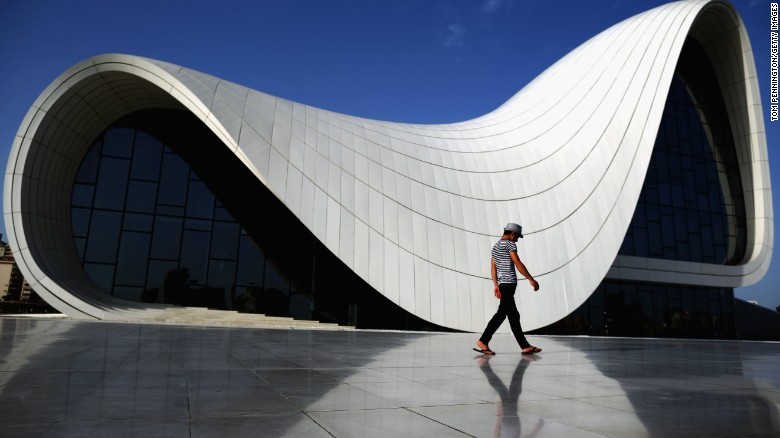
Zaha Hadid's Heydar Aliyev Center in Baku, Azerbaijan, is an architectural tour-de-force, a whirlwind of a building that takes the breath away.
Stormen, a performing arts and library complex named after the tempestuous weather that lashes the Norwegian city Bodø, is as modest as Hadid's Heydar Aliyev Centre is monumentally expressive.
Here British architects DRDH, who believe in self-effacing design, have married the sensibilities of a low-key Arctic city to the gently lyrical character of buildings elsewhere in the world inspired by Scandinavian design, like London's Royal Festival Hall.
The new Universidad de Ingeniería y Technologica in Lima, by Dublin's Grafton Architects, is a complex 3-D grid of internal and exterior spaces, walkways and hanging gardens, that responds in bold and stirring fashion to its unpromising setting between urban motorways and a sea of residential towers galumphing down to the Pacific Ocean.
And Briton David Chipperfield's Museo Jumex, shoehorned into a triangular site in Mexico City's crowded Nuevo Polanco district, is a travertine-clad sentinel in a jungle of wayward skyscrapers. Its chaste exterior part conceals and part reveals serene, lofty, well crafted and subtly day-lit galleries.
These six, extraordinarily different architectural propositions will now undergo a final on-site assessment from the RIBA grand jury, which is chaired by world-renowned British architect, Richard Rogers.
He will be assisted by Nigerian architect Kunlé Adeyemi, London-based Philip Gumuchdjian, the Dean of the School of Design and Paley Professor at the University of Pennsylvania, Marilyn Jordan Taylor, and New-York architect, Billie Tsien.
It will be fascinating to see quite how the jury comes to its difficult final decision, with the winner to be announced on Thursday 24 November.





|
Date
2016.10.27 / 17:15
|
Author
Valeh Mammadli
|